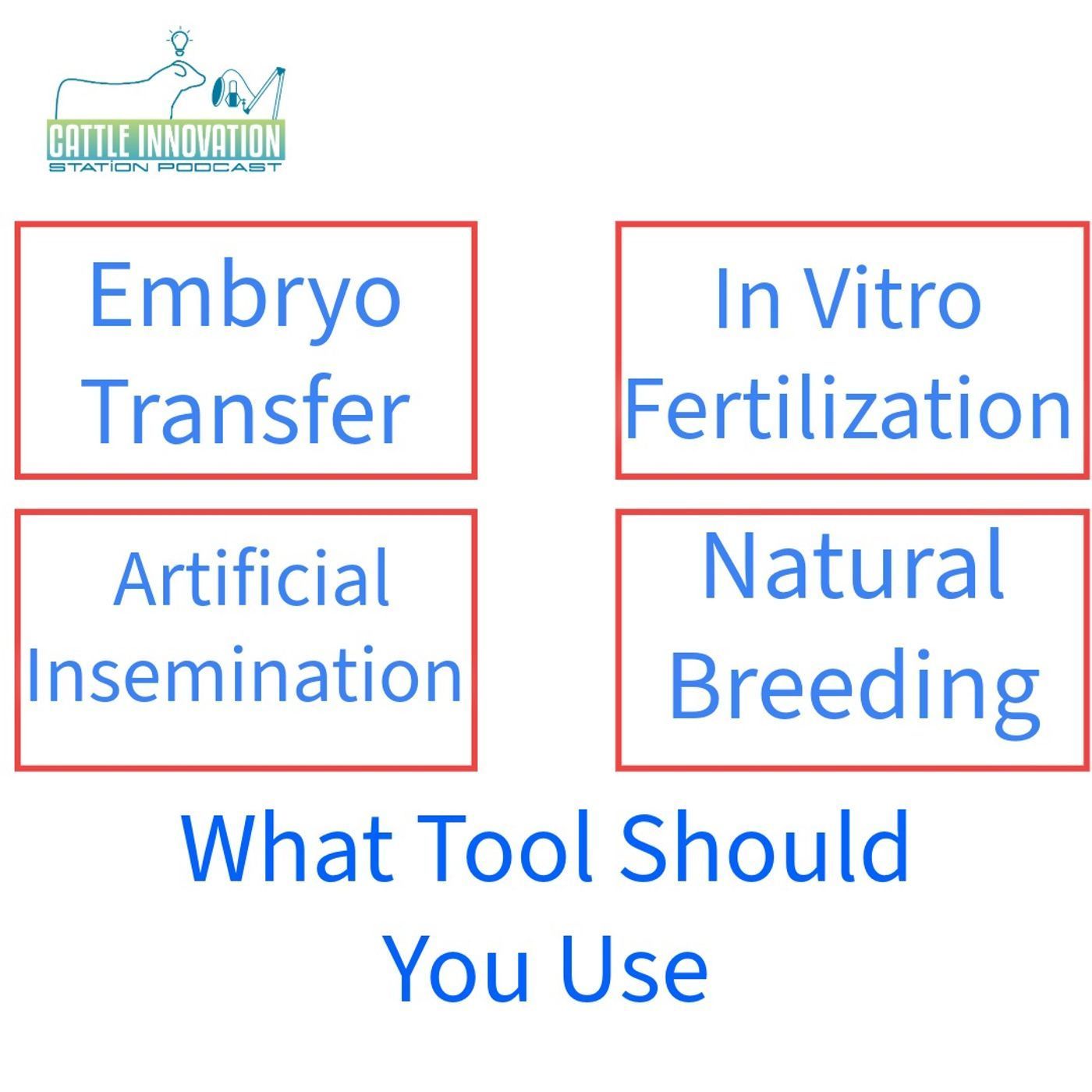
Artificial Insemination, ET & IVF: Which Fits Your Herd?
About This Cattle Innovation Station Episode
Accelerate Your Cattle Herds Production: Use Tools Correctly
How to utilize Embryo Transfer, IVF, AI, and Natural Service to benefit your cattle herd.
Have you ever wanted to grow your cattle herd exponentially fast while still have high-quality genetics. Actually, growing your cattle herd's quality and quantity are mutually beneficial. This episode of the Cattle Innovation Station podcast host guest Dr. Joe Madk. dives into the power using Reproductive tools to grow both you herd's quantity of superior genetic cattle.
In this episode:
How to utilize Embryo Transfer, IVF, AI, and Natural Service to benefit your cattle herd.
Resources & Links:
Cattle Innovation Station Podcast
Follow us on the streaming platform of your choice, share this episode, and follow us on Facebook, Instagram.
Baxter: Thank you for listening to this episode of the Cattle Innovation Station podcast. I hope you enjoyed this episode. And if you learned something from this episode, make sure to follow this podcast as well as liking and rating this episode and podcast. Thank you for listening and until next time, keep innovating the cattle industry. Signing off. Let's face it, there's some frustrations that you and I, we all have to face in the cattle industry. You breed a cow, it takes nine months for it to have a calf. There's a limited amount of bulls that you can have on your property, and a limited amount of bulls you probably want to have on your property. It's time for another episode of the Cattle Innovation Station podcast, where we keep you current on beef cattle industry events, help you innovate your herd to turn a profit and help innovate the beef cattle industry so we can feed more people on less land. I'm your host Baxter Whitworth and today I'm joined by Dr. Joe Mask. Dr. Mask, how are you today?
Joe W. Mask, Ph.D.: the Greg Baxter, how are you this morning?
Baxter: I'm doing good. Well, Dr. Mask, what can producers expect to learn about today and what is your expertise in?
Joe W. Mask, Ph.D.: I think that back through today we're going to talk about reproductive efficiency in the beef cattle herd and how reproduction really affects the bottom line. Here at Stephen F. Olson I teach classes in reproductive physiology, animal breeding and genetics, livestock evaluation, teach classes in ag leadership as well. And so hopefully, you know, taking back from my experience in the beef cattle industry, raising beef cattle myself with my family, my wife and daughter,
Baxter: And this can cause frustration when we're trying to get better genetics in our herd and replicate good genetics fast. But today we're going to be talking about the importance of reproductively efficient cattle to play a role in your herd's profitability. Spoiler alert, it's the foundation of your herd's profitability. And different reproductive tools that we can use to harness quality genetics that we may not actually have within our herd.
Joe W. Mask, Ph.D.: hopefully can give some stuff that where people can understand it's things that we talk about every day, but sometimes we forget about it when it comes to reproduction.
Baxter: Yes, sir. So I guess the first thing that we want to talk about is the baseline is and that is what is reproductive efficiency and how does Why is it important and how does it affect? and replicate quality genetics that we do have in our herd faster.
Joe W. Mask, Ph.D.: Well, I think, Baxter, when we look at just reproduction in general, it's the primary driver of profitability. In a cow calf operation, if a cow is open, she brings nothing to the table at the end of the day at wean the time. so open cows are zero revenue to the herd. And then with that, those open cows are still eating. still getting protein supplementation if you have that, or mineral supplementation. They're still getting forage supplementation during the wintertime. But at the end of the day, those open cows are not doing anything for you. And so I would say that every increase by 1%, we talk about a prey grade at time of a prey check, is significant to the bottom line in those cows that been exposed by a bull. And so as we start to talk about more calves on the ground, Basically, those expenses are cut across a little bit different sector. I would say the biggest thing is an open cow is a cow that needs to be culled.
Baxter: So we'll get to cool in a little bit and that's a great point that you bring up. I'm glad that you brought that up. So when it comes to reproductive efficiency and what we're looking at in cattle, how fast do we want cattle to be getting bred back after they've had a calf?
Joe W. Mask, Ph.D.: So that Kevin interval to me Baxter should be about 45 to 60 days. a lot of things are gonna play a part in that, especially when we're gonna talk a lot today, I know about body condition score and nutrition. And we can keep those cattle going into a third trimester at a five or six in body condition score. When she calves and starts lactating, ⁓ she has enough nutritional value there to keep a body condition score up where then in that 45 to 60 days postpartum she's re-breeding back. And so, know, the name of the game is a calf every year and nine months, you know, we've only got three months to get her re-bred back. And so I think that it comes back and, you know, to a lot of those things, not just the cow side, but the management side as well.
Baxter: Okay, that makes sense, thank you. And I think that's an important thing also because I've heard it said that if a cow isn't feeding at least two animals at one time, then she's not being profitable for you. So when we talk about cattle that are superior in their genetics and that are helping our herd be more profitable, A lot of times we like to think of tools that we can use to help replicate those genetics. So what are some tools that you think are most beneficial or even tools that can help us ⁓ grow the genetics of our superior quality cattle?
Joe W. Mask, Ph.D.: Well, think, Baxter, when we look at seed stock producers, we talk about progressive commercial cattlemen as well. There's three things that probably come to my mind when we start talking about accelerated progress through reproduction. Number one, that's AI, and that's artificial insemination. ⁓ We talk about embryo transfer, or the conventional embryo, where we're super ovulating the cow and then retrieving those embryos at day seven. a newer technology which is not new any longer. But one that I think we get a lot of progress out of as well as in vitro fertilization. And pulling those sites out of a cow and fertilize them in a Petri dish and then implant them in a recipient ⁓ at day seven. And so a lot of those things, think any time that we can try to get more offspring from an elite female, ⁓ that's gonna help our herd. And I think that those things that come into play are those tools. are beneficial, but we also have to make sure that we're using them to the best of our advantages.
Baxter: Yes, sir. That makes sense. And so you mentioned AI is one of those tools and we'll get to the other ones in just a second. But when it comes to AI, what are some of the great advantages that it can implement in your herd? I know obviously it allows you to buy genetics from a herd that are from an outsourced genetics that you might not necessarily have in your herd without having to purchase a bull. But what are some other advantages that it has for your operation?
Joe W. Mask, Ph.D.: Cool. I think actually you hit on that top tier deal is where we can analyze or we can go through semen catalogs or deal with different breeders in biogenetics in a straw. ⁓ know, by the spermazoa that is actually going to affect us and move that cow herd to a different level. I think the other thing it does is it allows us ⁓ when we start talking about cavities, we talk about growth, we talk about carcass traits, you know, maybe the bull that we're using right now is, is not, ⁓ you know, the highest in IMF or Marbling or, or rib eye area or whatever you want to say. But then all of sudden we can go out and we can buy semen on a bull that, that, has those traits. And we know being highly heritable that we can pass that on. And, the other thing, Baxter, I think that we're really starting to see now and out there in some literature and starting to see some articles, you know, growing up in the cow business, ⁓ you know, was always kind of around people that thought, ⁓ well, go find a low birth weight bull to breed your heifers to because that first calf is going to be sold at the sale barn or we're going to get rid of that first calf anyway. Well, I think with the invention of sex semen has really put on something different. We can now buy sexed heifer semen and knowing those calves are probably going be a little smaller, be a little bit more petite about their shoulders and head. And we can breed our heifers to more sex semen now. so worried about just you know the birth weight. You know we're worried about still calving these. We're still worried about those traits but it's the phenotypical traits that we can look at in EPDs and genomics that help us select the right bulls and now that first calf heifer is producing the calf that can be just as superior you know as a five or six year old cow.
Baxter: That's interesting. That's a very interesting take. I've never thought about before how the sex semen can also not only help your cash flow, especially if you're main selling, the main thing you sell is heifers, but also lower the birth weight of your cattle where you're having to focus less on that. That's an interesting point. ⁓ So when we're talking about AI, Something that we like to talk about or something that is really the main driver of this podcast is profitability in the cattle industry. And so I want to know, can AI, if you're selling semen yourself, can it help benefit you as bringing in more cash flow throughout the year?
Joe W. Mask, Ph.D.: Sure can you know, ⁓ you know those top sire since you have you know that you can market ⁓ You know, we have the best marketing tools now with social media ⁓ You know when we use social media to our advantage especially when we talk about marketing, you know We can start selling semen that you know, that's an extra benefit ⁓ You know, and we know that they're ⁓ You know, I do quite a bit of international work ⁓ And so there's a lot of international ⁓ buyers that can purchase semen that they can ship to other countries that can't normally ship maybe a live animal or they can't, you they don't have the ability to have that. And so I think that, you know, having the availability of collecting our bulls, we've got so many good places around now that collect bulls that we can store in liquid nitrogen. And then all of a sudden now that's another profit source for us. Are we going to make a lot of money? It just depends on the bulls. But I think it gives us the opportunity to share. genetics through rancher to rancher and still at the bottom line kind of take a little bit of that you know profit back from the bull side.
Baxter: Yes, sir. ⁓ I think that makes sense and it's in the cattle industry where it can be kind of hard to generate cash flow throughout the year. I think that's a great opportunity if you have that available to you. So we've talked about a lot of the benefits of AI and how it can help you increase cash flow, lower your birth weights and just help you increase the quality of your herd, but is there anything that we need to watch out for when we're using the ⁓ artificial insemination technology or things that we need to make sure that we're doing that it's not damaging our herd instead of helping it?
Joe W. Mask, Ph.D.: I think one of the, you know, it's not really a drawback, but it is one of those factors out there is it's labor, you know, it's a labor cost. Getting those cows up, you know, if we're going to use the estrus synchronization, if it's a seven day protocol or seven plus seven or whichever protocol we're using with, you know, G and R H and prostaglandins and a Cedar implant, you know, now we've got extra labor cost in bringing those cows into the chute. And I think we need to be very careful, you know, when we're using an implant gun for cedars cow to cow that we're making sure that we're disinfecting that ⁓ applicator. I think the same way as when we're AI on these cows, ⁓ making sure that we're doing the best thing we can possibly ⁓ to keep any type of microbiome out of that cervix, feces or whatever, ⁓ keeping that ⁓ uterus as clean as we can. ⁓ And so I think some of those practices are using a clean gun, a clean sheath, a clean glove, making sure that those cattle are as clean as they can be prior to going in vaginally to keep down any type of infections. And so, but I would still say that it's one of those technologies that's really safe to use. think we just have to the process in the protocol and making sure that we're as clean as we can be and making sure that cow is clean as well. And I think it just takes care of some of those issues that you mentioned.
Baxter: Yes, sir. And so I just I want to make sure that producers know that when they're using AI, obviously ⁓ what around what is the conception rate with AI?
Joe W. Mask, Ph.D.: you know, you're probably looking at It depends. That goes back to, you know, that technician putting in the semen. I think it goes back to the person that's watching, you know, the estrus cycle as well. You know, we've got tools out there, estru-tech patches. We've got, you know, there's a product out on the right now that we're doing some research here at the university, 701X ear tag, you know, looking at estrus cycle as well. And so I think that as long as we are taking care of business and making sure that those cows are in good estrus, I would say conception rates should be 80 % or better. But you're gonna have those situations where cows are gonna be, for as long as I've been AIing cows, there's some you're not gonna get bred. It's got difficult cervix, maybe their ovulation is not at the same time that you think it should be. And so we're gonna have some of those. But I would say that using a technology that's saving having a bull on your place, this tearing up water troughs or tearing up feed troughs or gates or whatever, it helps you out. And I think the other advantage that people need to know about Baxter as well is trying to define and really hone down their breeding season. And so if they're using AI and they're breeding those cows that ⁓ on the AMPM route at 12 hours after the onset of estrus and then we know about 18 to 21 days later they'll come back into estrus, you know, we can kind of start tightening up our overall cavity window as well. And so I hope that that answers the question you're looking for.
Baxter: Yes, sir. And so you mentioned that using AI can allow you to not have a bull on your operation. But for most operations, do you think that is a smart move? And obviously it is for some because I know of operations that do that. But do you think for most that's a smart move? as you said that the conception rate for AI is around 80%, which leaves 20 % of your cows to Possibly not get bread
Joe W. Mask, Ph.D.: So you're really kind of thinking about, Master, that looking at not having a bull in your place, is that kind of where the answer is, where the question is?
Baxter: Yes, sir. So my question is, even someone that wants to utilize AI heavily, should they still keep a bull around to clean up those cows so that they have a closer to 100 % conception rate?
Joe W. Mask, Ph.D.: Yeah, always, I always, you know, the guys that I consult with and even some projects that I have going on here, research projects I have going on university, I still keep those around. You know, because at the end of the day, just as we started this podcast, Baxter, the number one cost thing in in the beef cattle industry, in my opinion, is when we have open cows. And so even though we have a tough time, you know, trying to get some of these cows bred or, or maybe the technician wasn't right on that morning, or maybe we have an issue with the semen quality. There's a lot of things out there, and then all of sudden we've got a bull that we can put out after AI to kind of clean those cows up. Then we're more apt to get closer to that 100 % of cows bred. Now, I'm not gonna say that we're gonna have 100 % in preg check or whatever, but there's always issues. still a smart move if you can keep a bull around and then have a place to keep him during that AI session of time and then turn him back out. You and I have kind of visited a little bit and I think we're going to talk some about breeding seasons and keeping bulls out all the time. And I think that you have to look at what does your operation, or what can your operation sustain? Do we have a place to bulls that we have places to keep those bulls out of the way from the cows. But to answer your question really directly, yes, I still believe that a person ought to, if they have the ability, they should have a bull on their place or have the access to a bull they can put out after the time of day.
Baxter: Yes, sir. That makes sense. Thank you for clarifying that. ⁓ So I kind of want to move into a few of the other technologies we've talked about, ⁓ specifically IVF and embryo transfer. So how do you think either of those technologies can benefit someone's herd?
Joe W. Mask, Ph.D.: Well, if, you know... As I teach an animal reading, when we start to really recognize what our reading plan is for a year, we're not affecting the accountable, we're affecting the next generations. And so we've always got to be looking at how do we improve the next generation. And I think ET and IVF are those ways to get multiple offspring out of one female. And so we start talking just the IVF. excuse me, ET. We flush the cow, we get multiple embryos. Those embryos are raised in that cow for seven days. Then we flush them out and then we put them in a recipient cow. And I think that those eggs might, I don't know the literature on it, but maybe they're a little stronger than IVF because they were grown in the cow. I don't know. But I know this, is that that technology allows us to get multiple offspring. not a guy that thinks that we need to flush every cow. don't think every cow or every heifer that wins the county show is a donor prospect. But I do think that those superior genetics that we have in our herd, we can use this technology to get further away from it, away from kind of status quo. I have a philosophy on my own place. is just Joe speaking. I don't flush a cow till she's had a calf. Or maybe I'd like to have two calves. I want to see how can she raise a calf first. However, some people they flush cows as version heifers and I'm okay with that. I think every operation is different. I think it goes back back to her in my opinion when we start looking at these type of technologies. It's about marketing. How do we market our genetics and how do we you know, how do we stay profitable? And so if we want to accelerate genetics every year ⁓ That's one of those technologies. think IVF has started something or has been one of those technologies that it really helped us, especially when we look at a female that ⁓ once she's maybe a virgin heifer, maybe a heifer that's already bred, that we want to collect all sites out of, ⁓ that gives us that opportunity to think about that because it back to marketing. If you've got a really nice heifer or a really nice cow and you have a customer that calls you and say, I would really like to buy 20 embryos. And you say, well, the cow's bred. You're going to have to wait another nine months or whatever before I can do that. As long as that track is not over the realm of the pelvis, we can go in there and we can collect those sites and we can grow those embryos. And once again, that goes back to your point about how do we get profit throughout the year. so IVF has allowed us to do that. IVF has allowed us to grow those ⁓ in a Petri dish. ⁓ It's also allowed some people to use less semen. I think there's a debate out there if that's a good thing or a bad thing. But IVF gives us that opportunity to generate ⁓ and accelerate gain throughout the year with that technology. And the other thing I think is really important is, we've all had that special cow or special heifer and for some reason something happens to it. If that cow dies or something like that, there's a protocol, you can work with your veterinarian, can work with repro centers to harvest those ovaries the way that they need to be harvested and get them there. And there's a possibility of still trying to collect those sites out of those ovaries after that time. And so I think that's another one of those advantages that we have with IVF. But once again, I think we've got to use the smart. We don't need to produce a lot of bad ones. And that can sure happen because of the fastest way we can use it. But I think if we use it to our advantage, we look at the global marketing that we have in our own operation. And I think that's where it really helps us.
Baxter: Yes sir. So you have talked about differences between IVF and conventional ET. ⁓ Can you kind of give some examples of if this is kind of how your operation works, you might want to lean towards conventional embryo transfer, whereas if this is how your operation works, you might want to lean towards IVF.
Joe W. Mask, Ph.D.: I think it really goes back to that cow. And there's gonna be some cows that aren't gonna respond good to embryo transfer after they've been flushed several times or several years or what have you. And then we have the opportunity to go in and collect and retrieve those oocytes through IVF, because they're still there. But maybe she's not responding to a super ovulation drug any longer or hormones. And then all of a sudden, we don't have the advantage to use an ET. ⁓ I think sometimes we can look at ET as ⁓ probably a lower cost ⁓ than ⁓ IVF because just the numbers we're going to get and the cost of retrieving those embryos and implant them, they're just not going to be ⁓ as much. I think sometimes people will say that conventional ET can be more predictable. ⁓ I don't know if I really buy that or not. every cow is a little different. I will tell you personally, we've got a cow that, you know, she, ⁓ we've never done conventional embryo work owner. I've only done IVF and she produces unbelievable. You know, and so I've had other cows that, you know, they're not as good, you know? And so I think that, you know, it really depends again is where, ⁓ where those... ⁓ What are your priorities, I think is where it really goes to. And how do you want to either select for genetics or pass on your genetics or sell your genetics? I would say that IVF, if you're looking for higher numbers and you're looking at something that you can do more often, because of the oocyte retrieval, we can do it more often than we can do super ovulation in regular embryo work. And so I would think it would just be, much do you want to do. And the other big advantage, think, with IVF, not to this horse to death, but I think is the variability of being able to separate those oocytes in different ⁓ petri dish and be able to use different bulls and fertilization of those oocytes to make embryos. And so I think that that gives us a different advantage as well. So I really think it goes back to your management style, your herd needs, and also your market. meetings.
Baxter: Yes sir. so, ⁓ correct me if I'm wrong, but I believe another advantage to IVF is that ⁓ by utilizing IVF, your semen is most likely unless there's an issue going to take to those O-sides, correct? And so by utilizing IVF, if you're using expensive semen, ⁓ then that's kind of a more guaranteed way that you'll get a...
Joe W. Mask, Ph.D.: step.
Baxter: calf if I'm not mistaken. Is that right?
Joe W. Mask, Ph.D.: Yeah, and I think tube actually gives us the opportunity, as I mentioned, to ⁓ be able to cut that straw under nitrogen, ⁓ keep it frozen, and only thaw out a portion of it that we would need, and not having to utilize a whole straw. Because we know that it doesn't matter what breed you're in, it doesn't matter what we're talking about now. Semen costs have gotten expensive. And so if we have that really special straw of semen, there's the technology out there that we can cut it. ⁓ and utilize even parts of it and not having to follow that old straw. And then it goes back to, like you said, in conventional AI, I've got to be able to get that cow bred. And so that AI technician or the embryo technician that's actually breeding that cow seven days prior has got to be on their game as well. And so it does give us an opportunity to be there. to have probably a little bit more success over.
Baxter: Yes, sir. Well, ⁓ I do want to talk about because we've talked about IVF and ET as well as AI and there's also natural breeding, is ⁓ just running the live bull on the cattle. But in which scenario do you think we should use AI or sorry, IVF or ET versus AI or versus natural breeding? Which scenarios do you think those work best in?
Joe W. Mask, Ph.D.: I think it goes back to profitability. profitability increases when we start to use different technologies and we match those technologies with our operation goals. There's a lot of times that we can run bulls on cows ⁓ if we're very ⁓ disciplined and it works just as good. We buy the right bulls, we match the right bulls. I know producers and some that I've worked with and some I work with right now in some projects, they're 100 % bull. bullbred cows. ⁓ But I think they're very disciplined ⁓ into when they put the bulls out, when they pick the bulls up. And so I think it goes back more than anything is. matching the technology to your operation. If we look at natural service, that's the lowest labor cost there is. We put a bull out, bull does his job, you know, in an all reality, 45 to 90 days, however long your breeding season is, you pick the bull up. You're going to get the least amount of genetic improvement ⁓ out of that scenario if you're not replacing and buying new genetics to fit your needs. The other thing that you have to worry about there is injury to those bulls. Is the bull going to get injured throughout the breeding season, ⁓ reproductively, ⁓ throughout genitalia issues? Does he have a bad foot? Does he have a corn? Does he break a toe? ⁓ And then the bull comes up lame and he's not breeding cows. And then the other issues that we have sometimes is infertility in these bulls. And so natural service sometimes 100%, yes, low labor costs, but we've got to be, I think, visual. And we still got to be with those cows to make sure the bull has the libido, or the libido, however you want to say it, to get up and move and get those cows bred. As well as making sure that if there is a bull, It's not moving a lot. If you're seeing him under the shade tree or you're seeing him in the pond during breeding season, is it an issue? And so I think that there's where we have that. We talk just AI versus some of these other technologies. I think it's the best balance when we talk about cost and genetic improvement. It's a lower cost to AI and you get that genetic improvement, but it requires a lot of management and timing. You know to get these cows bred. You know I'm very fortunate Baxter that I have a wife that's been married to me for a long time. That's really good at catching estrus in cows. She also AIs, my daughter AIs. So we have three people at our house that can actually thaw cement and put it in a cow. Now when it comes to those bad cervix cows who do you think is going to get the phone call that needs to get them bred? ⁓ The guy that's been doing it the longest. However, you have to make sure especially in AIs do you have the ability to do it or do you have a technician that you can call? Because there's times that I breed cows at three o'clock in the morning because they come in desks at three o'clock in afternoon. And so I think those are those things that, you know, it's a low cost, but it gives you some genetic improvement. But then you have that management and the timing part of it. know, IVF, ET is the highest, you know, genetic acceleration of your herd because we can do so much in a year. ⁓ It's a higher upfront cost. It still goes back to ⁓ that management of time. But I will tell you for, in my opinion, in the people, once again, that I work with, those seed stock producers and those really progressive commercial cattlemen, because I work with one that's really progressive. He's a commercial cattleman. All his cattle go to a sell one facility, but they're grouped together and everything. But he gets a lot of benefit with IVF. But he's progressive and he wants to make sure those calves are where they need to be. To sum all that up, I'm going go back to where I started, Baxter, and I'm going to say that profitability increases when we mix technology into our management decisions.
Baxter: Yes sir, so I love the point you made of matching the technologies with the goals of your operation and with your operation because not every operation is at the same level of growth, not every operation has the same goals or even operations that might have similar goals and are at a similar stage of growth might be in a different environment and have things that are different within them. I love that point and thank you, Dr. Mask.



 Apple Podcasts
 Castbox
 Castro
 Goodpods
 iHeartRadio
 Moon FM
 Overcast
 Pocket Casts
 Podbean
 Podcast Addict
 Podcast Republic
 Spotify
 YouTube