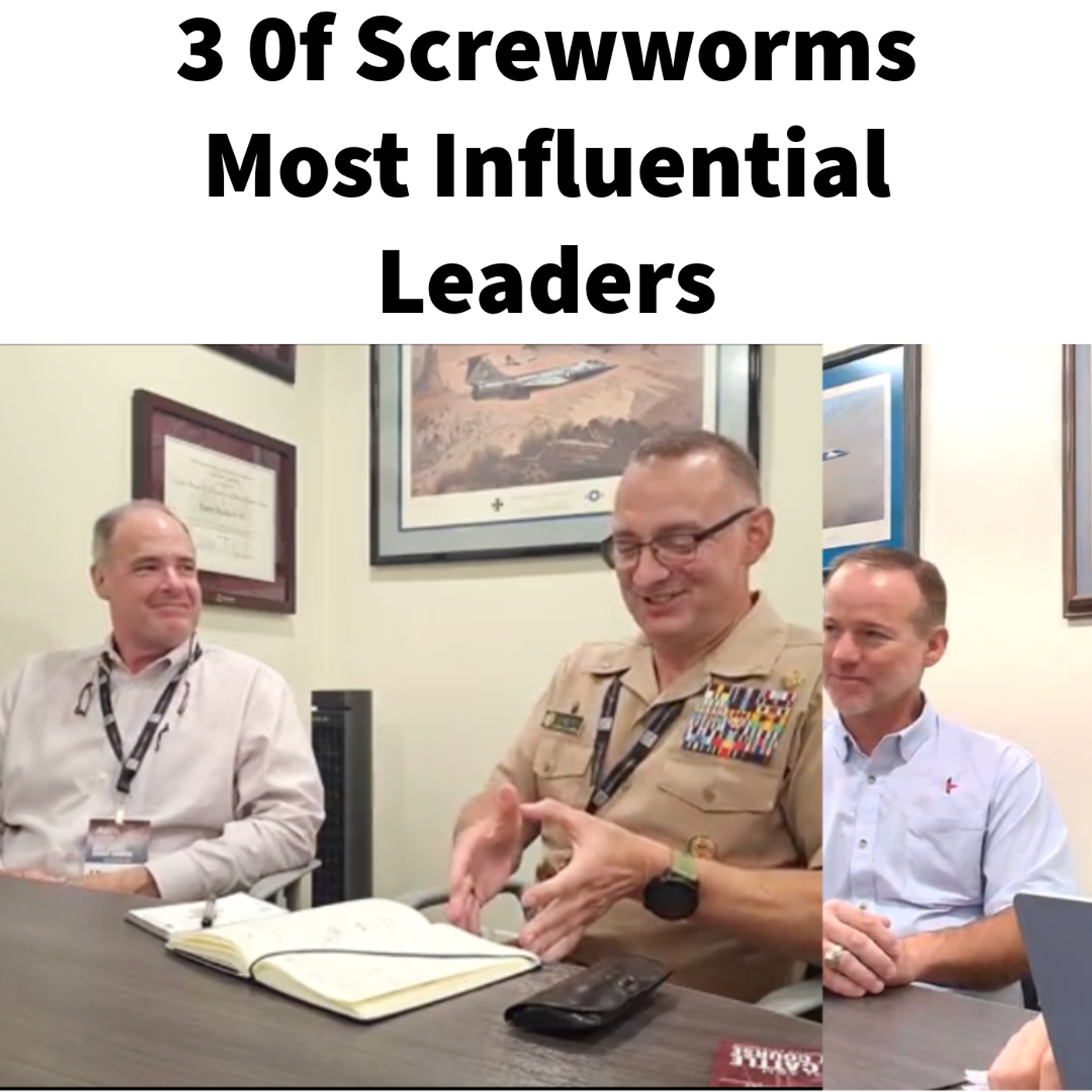
New World Screwworm: 3 of the Most Influential Leaders in One Interview
About This Cattle Innovation Station Episode
New World Screwworm has entered the United States — and in this episode, host Baxter Whitworth sits down with the three people most responsible for stopping it: Admiral Michael Schmoyer, Associate Administrator at USDA APHIS and Director of the New World Screwworm Directorate; Dr. T.R. Lansford, Deputy Executive Director and Associate State Veterinarian at the Texas Animal Health Commission; and Tracy Tomosik, Commodity and Regulatory Activities Associate Director for Texas Farm Bureau. This is the first time all three have appeared together in one interview on the outbreak.
What Is New World Screwworm?
New World Screwworm is a parasitic fly whose larvae consume live tissue in open wounds on warm-blooded animals, including cattle, wildlife, and occasionally humans. It's highly treatable when caught early, but left unchecked it can cause severe wounds and death losses in a herd.
How Big Is the Sterile Fly Response?
Since February, over 627 million sterile flies have been released in Texas as part of a decades-proven population-suppression strategy, according to Admiral Michael Schmoyer. A newer strain called NovoFly allows production of male-only sterile flies, effectively doubling the field impact of every batch produced. Schmoyer says officials are targeting 500 million flies a week to fully contain the outbreak — up from the current 100 million.
What Should Producers Do If They Suspect an Infestation?
Dr. T.R. Lansford outlines the process: monitor animals for wounds, especially wounds containing maggots. Collect a sample using a screwworm kit (available through a veterinarian or AgriLife Extension), contact the Texas Animal Health Commission before mailing anything, then treat the wound and manage it with an accredited veterinarian. Fast identification allows sterile flies to be deployed into the area within 24 hours.
Why Does Livestock Movement Matter So Much?
Admiral Michael Schmoyer, Dr. T.R. Lansford, and Tracy Tomosik all point to the same root cause: uncontrolled movement of infested animals is what let screwworm break through the historic biological barrier at the Darién Gap and eventually reach Texas. Movement controls — inspection, ID, and permitting before animals can be transported — are now central to preventing the same failure from repeating.
Key Takeaways:
- New World Screwworm is treatable and not a food-supply risk, but requires fast identification and reporting
- 627+ million sterile flies released in Texas since February; NovoFly technology is doubling effective output, per Admiral Michael Schmoyer
- Movement of infested animals — not the fly's own flight range — is the primary driver of spread
- Case rates are trending flat to down, but Schmoyer cautions it's early — only the second fly life cycle since the outbreak began
- The long-term U.S. goal is pushing the fly back to the Darién Gap, as was achieved decades ago
New World Screwworm Playbook: https://www.aphis.usda.gov/sites/default/files/nws-response-playbook.pdf
Baxter Whitworth: I am probably not the first person to tell you this, but the New World Screwworm has entered the United States. And in this interview and in this episode of the Cattle Innovation Station podcast, you will be listening to some of the world's foremost authorities, knowledgeable people, and influential people on the New World Screwworm. We actually have three people in this interview. We have Mr. Tracy Tomosik, who is the Commodity and Regulatory Activities Associate Director specializing in livestock and animal health with Texas Farm Bureau, which means he he is a lobbyist for Texas Farm Bureau focusing on livestock and animal health. Also, we have Dr. T. R. Lansford, who is the deputy executive director. an associate state veterinarian for Texas and for the Texas Animal Health Commission. This means that he is one of the people at the top on the state level that is responding and and taking action on the New World Screwworm. And at the federal level, we have Admiral Michael Schmoyer, who is the associate administrator, which is a very high level position for the animal and plant health inspection service, APIS, under the United States Department of Agriculture. And he is the director of the New World Screwworm Directorate. So his job is getting read and pushing New World Screwworm out of the United States at the moment. So I hope you enjoy this interview. I hope you learn a lot because These people are some these people are knowledgeable and very influential about what is happening with the United States and Texas related to New World Screw One. It's time for another episode of the Cattle Innovation Station podcast. I'm your host, Baxter Whitworth, and today we're going to be talking about the hot topic of the New World Screwworm. With me today, I have Mr. Tracy Tomosik, Dr. T. R. Lansford, and Admiral Michael Schmoyer. Got that right that time. So we're going to be talking about what New World Screwworm is, how to treat New World Screwworm, the plan to get New World Screwworm out of the United States, and if we Half time we'll get to what we're doing from a policy aspect when it as it relates to New World Screwworm. So just as a kind of a quick refresher to some of our listeners, if they don't know what New World Screwworm is, what is the New World Screwworm? So New World Screwworm is actually a a fly pest. We use the word screw worm because what we see typically is maggots or the larval stage or the worm stage of the fly in a wound on an animal. And so everybody's seen maggots before in in an animal or in trash. this is the screw worm, is another type of blowfly that creates maggots. The difference is this screw worm maggot consumes live flesh, so it eats live tissue. And so from a standpoint of animal health, it creates an economic piece, it is a highly treatable condition, but certainly as a as a pest goes, it Creates significant wounds can create death losses in animals. and it's also important to think about the fact that it's not just a livestock and wildlife or wildlife issue is the pest or parasite will attack or or infest any warm blooded animal to include rarely birds and and people. All right, thank you. So before we go any further, could y'all all kind of state y'all's influence and role that y'all play in combating the New World Screwworm? Certainly. So I'm the assistant veterinary state veterinarian with the Texas Animal Health Commission and the Texas Animal Health Commission's charge or mission is to protect the health and marketability of the state's livestock industries. And so our role as the lead agency for responding to new world screw worms includes passing rules and implementing response plans to do everything we can from a regulatory standpoint to help minimize the impact of neural scorms. And so we'll get into this I'm sure as we go along, but those things include rules related to movement controls so that we can make sure that animals are inspected, treated, ID'd, and receive permits to to move safely. and also we help coordinate with our other state partners, Texas Parks and Wildlife and our federal partners from USDA, multiple groups within USDA and other agencies across the state in the and the federal government, in addition to our industry partners like Texas Foreign Bureau and and Texas and Southwestern Cattle Raisers and all the other livestock industry groups to respond to the threat. associated with the incursion of U-world schoolworm to make sure that one we're doing good outreach to keep everybody informed of what's going on, to give the current updates related to response activities and then work with our federal and state partners to do an all encompassing approach in terms of not just livestock but dealing with the wildlife and potential human threats associated with this pest as well. Yes, sir. again, with as Dr. Lansford mentioned, Texas Farm Bureau, I'm employed with the organization and I'm one of many livestock and commodity organizations in the state of Texas that have a have a membership-based interest in the control and eradication of New World Screwworms. So from a staff standpoint, I focus on the policy and regulatory issues that evolve around livestock and animal health. And as a as a representative staff member for the Farm Bureau members across Texas, I go to work on their behalf in accordance with their policies that are made on an annual basis. And in this particular instant instance, New World Screwworm has really taken over a lot of the bandwidth that goes of my my office. So thanks for having me here. Yes, sir. Thanks for having me as well. So I am an associate administrator at the US Department of Agriculture. And there I'm also the director of what's called the New World Screwworm Directorate. And so as a public health officer who's been assigned to USDA and have orders cut there, what we do is we synchronize all of the different federal bodies that are working on New World Screwworms. So that could be Department of Homeland Security, Department of War, Environmental Protection Agency, FDA, Centers for Disease Control and Prevention, USDA, and so on and so forth. So for the first time in USDA's animal health history, we have one particular body who is synchronizing all those efforts. So we can better work with our state partners and our industry partners and and have a seamless response as it relates to New World Screwworm. Yes, sir. Well thank you all for that. So we know what New World Screwworm is now. If someone is if someone thinks they might have a New World Screwworm infestation on their operation, What do they need to look out for? What do they need to do when they have the suspicion that they have that infestation? what it from a monitoring standpoint and an action standpoint, what do you need to do? Yeah, absolutely great question. And so especially now that we've got new world screw worms in the state, we've been talking about for a period of time to the best thing you can put on animals is eyes, right? Certainly that holds true now that we have screw worms in the state. And we're encouraging everyone for a number of reasons, but we're encouraging everyone to monitor animals for wounds, especially wounds with maggots inside them. So, again, as I mentioned before, it's not necessarily that every maggot inside a wound is gonna be a screw worm, but we need to to get samples of those maggots and confirm or you know, rule out screw worm infestation. And the reason that's so important from a response standpoint is the sooner. we can confirm that it's new world screw worms in that wound, the faster we can get and deploy sterile flies into the area to deal with that natural or fertile fly population in the environment. And so from a from a reporting standpoint, there's a number of kits out there and a number of resources out there to help folks walk through if you need to collect a sample of maggots in the wound. certainly you can contact your your veterinarian for assistance with that. go to your AgriLi Extension agent to get screwworm kits, look at our webpage to to find out how to do a do-it-yourself kit. but the important part is to collect those maggots out of a wound, get them into a container, and then call the Animal Health Commission. So there's some kits that AM has through a a grant with USDA has put together and they come in a box that has a mail label on there, a shipping label. And it's important right now that you don't just collect that sample, put it in a box and stick it in the mail. We have assets now in the state, lab assets in the state, that make it where we can get those samples and do a much faster job of identifying screw worms or not screw worms as the case may be. but you need to contact the Animal Health Commission if you collect that sample. And then after that, the critical part is kill the maggots and treat the wound. Because again, at the bottom at the end of the day, this is a a wound. And so once you get the parasites out of it, regardless of what what they are, treating that wound and and using appropriate antibiotic therapies and wound management techniques and monitoring that wound for healing and working with your accredited veterinarian through that process is is really important. Yes, sir. So does that require a vet to kill those maggots? And to heal that wound if the wound may not be as far along? So certainly there are a number of products that are available to treat screw worm infestations or maggot infestations in general. And those kind of are broken into two categories. There's the topical products, and that's when you start thinking about some of the permethrin sprays and and some of those compounds or or products that have an insecticide in there that can be applied topically, that certainly can be used over purchased over the counter. For use for that. But in terms of systemic products, and so that's especially in areas where new world screw worms are confirmed or in an area where they have been confirmed, is important because those systemic products give a longer period of protection. And so many of those products do require a veterinary prescription to obtain. And certainly if you have a wound and need to give antibiotics or pain management, any of those things require involvement. So it's not necessarily that the veterinarian has to do the treatment, but you have to have as a producer or an animal a valid veterinary client-patient relationship to be able to get those products to have on hand to do the treatment. Thank you. So my next question is: what are we doing to what is the strategy? What are we doing to push New World's Crew Arm out of the United States? Yeah, so that's one of my favorite questions that people ask. So I'm sure you've gotten it a lot recently. I get it a lot. And the nice thing is the the overarching responses is we work together, right? And so I've had the opportunity over 25 years to focus on biological threats, 24 of those years, biological threats that are outside the United States. It's my first time being able to work with it in the United States. So for me, very much an honor to be able to do this. And so what I have learned is the way that This problem is being addressed by our state partners, by our industry partners, is unlike anything that I've ever seen before. People are all rowing in the right direction, all rowing in the same direction. The color of their oars may be a little bit different in how they think that they need to rope, but everybody's rowing in that direction. So that allows us to look at four different things that we can do to operationally affect this particular issue. The number one thing that we're doing is animal inspection. So Texas Animal Health. Critical, critical part of that, Texas Park and Wildlife. That is a fundamental thing that we need to continue. The second thing that we're a big part of is also trapping. And so what we do is we actually work through the Texas Park and Wildlife Division to be able to get landowner approval to be able to trap for New World sterile, excuse me, New World Screwworm flies. So if you look at our fun family friendly website, screwworm.gov, you'll see that there's a zero for the number of screwworm wildflies that have been caught. And that's a good thing. When we look at the actual number of cases, so as of about 15 minutes ago, since June third, we've actually in our traps collected 79,661 flies. They're a mixture of blow flies, but they're also a mixture of New World Screwworm sterile flies. So the flies that we're releasing are being caught by this. And people ask me, well, why is it that we still have zero wildflies in those traps? What we have found is after decades and decades of research, that is normal. When you are suppressing a population with an overwhelming amount of sterile flies, that is going to result in you having zero wildflies being trapped. Very good. So we've been doing this for a couple of decades. So trapping is a second one. Third one is wildlife monitoring. And so again, as of about fifteen minutes ago, we've had over fifty seven thousand D Mont, if I say something real fast just for the listeners. This is August August fourth. this won't come out on the fourth. So I just want people to know what day we're talking about. Anyway, go ahead. so since July 1st, we've actually had 57,000 wildlife observations. And when we've looked at those wildlife observations, 14 animals were animals of interest. Zero were found to be New World Scuberman infestations. And so this is really important. so we have animal inspections, that's important. So that's very important with Texas Animal Health as well as Texas Park. wildlife trapping is really important to know not only whether or not there's wildflies but how well our sterile flies are doing. number three wildlife monitoring is critically important. And then number four, my favorite the sterile fly releases. And so a lot of people are asking well how many flies have you released in Texas? Thank you for answering or asking that. So over 627 million flies since February of this particular year have been released. Sterile flies have been released. So 626,700,880 flies specifically as of last night have been released in Texas since the beginning of February. So when I mentioned before about the trapping and there being an overwhelming number of New World screwworm sterile flies, this is what overwhelming means. And so when we look at our cases now, when we look at the results, people still continue to see the total number of cases. What I challenge people to look at is also look at the total number of active cases. Look at the total number of inactive cases. And most importantly, what is the rate of infestations that you're seeing? And so what we're seeing is that rate had a little bit of a spike the third week of the response, and then it has either leveled out or actually gone down a little bit. And so it's really early right now in the response to be able to say, what does that mean? Other than we are moving and trending in a positive direction, but we are still only in the second life cycle of the fly. And so three, four, five life cycles of the fly will get a better understanding of exactly where we are and where we're likely going to be. So four things important: you know, being able to look at animal inspections, being able to look at trapping, being able to look at wildlife inspections, and being able to look at that sterile fly dispersal. That's what we're doing. There is a plan. We've been working together for over a year to do this. And Texas is one of the most prepared states out there for where we are right now in this response. Baxter, can I can I follow up with something that the Admiral said? You you mentioned that you're releasing sterile flies, but you started in February and we didn't have an infestation until June 3rd. That's right. Can you explain why? Yeah. That case that timeline is that way? Absolutely. And so so USDA has been working on New World Screwworm for decades, since the sixties. And so so we have been working on this for a very long time. We've been monitoring, we've been addressing it in a variety of different ways. Over the last two years, we started seeing the New World Screwworm starting to move up through Central America, through Mexico. And we worked really closely with Mexico, as Dr. Lansford has said many times, and I'm very appreciative of to slow the New World Screwworm fly down, right? So a hundred million sterile flies a week, which is what we're currently producing, is not enough to stop it. We need, based on history, about 500 million. And we're getting there. And production is coming along. New fly factories have already started to come online as of a couple weeks ago in Mexico. We have another one coming online in the spring in more, more airfield in Texas. But 100 million right now is not enough to do anything other than slow it down. And so what we've been able to do is leverage technologies that we did not have in the 1960s and 70s when New World Screwworm was here in the past. So consequently, we can use things like artificial intelligence, we can use effective policies. We can use education and training with Mexico. We can work with Mexico to develop their first wildlife surveillance system and work with Mexico to develop movement controls. So I want to emphasize that last one, movement controls. What we have found over the last year and a half, actually over the last several decades, is movement is the biggest issue associated with a new world screw worm fly. And it's not the fly itself moving, but it's actually people moving an infested animal. So when we have our sterile flies in a geographic area and somebody moves an infested animal beyond that sterile fly area, then we have to move our flies again to keep up. And so consequently, to answer Tracy's question, finally, really what we were doing is we were watching the fly move, and we were concerned back in January and February, based on where we saw the fly in Mexico, that it could move to Texas, not a day later. Not a week later, but multiple weeks later. And so we started working with our partners to be able to say, hey, for the first time in decades, we're actually going to start dropping New World Screwworm sterile flies in Texas about 50 miles north of the border. And so we were well prepared to be able to stop that movement of the fly in that particular geographic area and were effective at continuing to slow it down for many months. Yes, sir. So building off of that. Now that New World Screwworm is in the United States, it's in the state of Texas, how do you 'cause I know that you have the quarantine zones that have where the New World Screwworm flies b there's been a confirmed case. So how do you strategically utilize those limited resources of flies that you have with those different zones? Yeah. So so It goes back to what I said right at the beginning, which is the partnership, right? And so working together to make sure that Texas Animal Health is doing movement controls. Really, really important because it prevents people from moving infested animals beyond our flies, right? number two, being able to work with industry partners to train and educate our producers to be able to say, hey, you know, our our our New World screw room sterile flies are not going to cause you a problem. they are actually good things. You do not want to get rid of them. They are very friendly to the environment and they are very effective. And we've seen that for decades and decades. Using technology like artificial intelligence to be able to take into consideration the climate, the wind, the topography, past cases, the biology of the fly to help determine where is the best use of our flies and where we put them or where we disperse them is incredibly important. And so really what we need to do is it's it's a multi-factoral issue. Where it's working with partners, using best practices as far as animal and movement control, being able to use science to determine how we can best deploy a resource that is limited, and then being able to work with our partners in the field and those producers to educate them. Here's what I would say: we have 100 million flies right now, roughly about 75, 78 million per week are being dispersed in Texas. We have flies that are actually being dispersed in northern Mexico as a biological barrier to be able to protect Texas. We have enough flies right now to be able to utilize for the cases we have in Texas. If we continue to have this partnership, if we continue to work with producers on the ground, we have enough flies to do this. We need you and your listeners to be able to tell us where there are cases so we can drop flies in 24 hours or less. That that's a great point. Baxter. And what we've been doing from an organization, a producer standpoint, is over the last, I guess it's been about sixty-three days of of infestations in Texas, there have been likely hundreds of of producer meetings. And they're more more than a meeting, it's more of a gathering. from a dozen people to twelve hundred and fifty in one location at a time and bringing in these experts to have a direct person-to-person conversation about what we need to do as landowners. livestock managers and wildlife managers to to pull our weight in this response. And that first and foremost is the identification of those infestations and letting these folks know what the where they are so we can respond effectively. Yes, sir. And I'll add I'll add one more thing, one more thought to go along with what Tracy just said there and what the Admiral has sh is shared. I think from the standpoint of producer cooperation, it truly is this is all hands on deck today. with this and and the producer, landowner, livestock manager, wildlife manager, the the criticality of of reporting a suspect case so that we can make that determination to get sterile flies in the environment when it is confirmed as screw worms is important for not only suppressing that population right there, but in the bigger picture, making sure that we're doing everything we can to protect that valuable limited resource of sterile flies in terms of not getting more infestation. And so that's also ties back to the movement control piece and why that's so critical. So we look at 1972 with in the outbreak that we had in Texas, there were nine excuse me, nearly 91,000 cases of screw worms in Texas. And that was because it got spread through movement. We're trying to prevent that because we don't have the sterile flies that we had in 1972. to deal with that situation. And so again, it's protecting everything we can do to protect the the the the effectiveness of that that limited resource that we have through sterile flies. To reinforce what he just said, in the seventies we were producing five hundred million sterile flies on a weekly basis. So we're we're one fifth of of the capacity right now. Can I speak to that? Because I I want to be able to share with your listeners where we are, right? And so So I understand today is August 4th and things will continue to evolve. But right now, yes, we have 100 million sterile flies that we are producing in Panama, right? And those 100 million sterile flies are what we're using now in Texas as well as Mexico. A few weeks ago, we had another plant, a production plant come on in Mexico in Matapa. And this was a fruit fly production facility that we provided about $32 million to Mexico to renovate. And in about 11 months, they became a new world screw worm production facility. So even though they were already producing insects and they were already sterilizing insects, it still took 11 months to be able to make sure that it could do new world screw worm. Ultimately, we expect, based on what Mexico has shared, by the end of the year, we hope to have about 100 million sterile flies coming from there. Right? So that brings us to 200, which is a little bit better. Next spring, more Air FIA, more airbase will have phase one complete. And phase one is starting to turn on the lights, open the doors, let people into work, and roughly about six months after that, we'll get another 100 million, which brings us to 300 million, right? by the end of next year. One year later, so 2028, in the spring, phase two at Moore Airbase will be finished. Phase two, once the lights come on and the doors are unlocked and people start working on phase two. About six months later, 200 million more flies. And so that brings us to the 500 million marker. Wait, there's more. All right. One of the things I also wanted to share is you asked about, you know, what are we doing differently and how are we addressing things? Being able to use innovative technology is a real critical part to the solution. So we have a new product. This is American technology that has been improved on. So as Dr. Lansford was talking about in the 60s and 70s. We had sterile flies. So the US government had developed that, invented it, and deployed it, and it worked. And it continues to work for decades. But we've been able to improve on that with a new strain called NovoFly. And what NovoFly does is it takes that strain, it gives it a chemical signal, and it signals that particular strain to only produce male flies, which we then sterilize. So what happens is when we talk about, hey, right now I have 100 million sterile flies, I only have about 50 million that are actually working for. And the reason is because we're taking that 50 million sterile male flies, putting them in the field, and then they mate with wild flies, don't produce offspring, suppress the population. But I still have those 50 million female sterile flies that really don't help in the field. And while they're lovely critters, they really don't do anything for me in the fight. And so they're kind of a waste. And so if I can have just male flies, then it is doubling my output. So where something would seem like about 500 million, because remember, half are male, half are female. If they are all male strain flies and they are sterilized, all of a sudden 500 million becomes the equivalent of about a billion New World screw room sterile flies. So what does that mean for you? That means we get to what we need to accomplish much faster, right? Right. So I'm gonna equate this for the people listening to s utilizing sex semen to get a heifer or bull that you would instead of the other one so that whatever your operation great analogy. Absolutely. I would start using that one actually really. I've been saying sexing chickens, but that is much better. Yeah. So you you've talked about what we're doing now. I wanna know the long term plan. kind of maybe you're not a obviously you can't say when it'll be out of the United States, but kind of a long term projection of when when you think we might be able to kind of move this out of the United States. And then also the long term goal. I know last time we pushed New World Screw Armament past Panama, to that isthmus there that's narrow. Is that the goal this time or do we want to go even farther? What or what's our goal this time? Yeah, so I'll I'll do do the second question first, which is what is the goal? And so the goal so I'm a knuckle dragger uniform guy. Right. And so my job is is just work with an awesome team and work with fantastic partners to do the job. Right. And the job that's been given to me is push it to the Darien Gap. So that isthmus between Central America and South America, push it down right there. And so our Panama production facility is right there. And what we had done for decades and decades was hold it there. and so so here's the thing when we have that Novo fly that I talked about, you know. possibilities are that we could do even more. But that's a policy decision and that's a political decision. It's also a long term strategy that really has to be developed. You know, being able to put out flies requires a few different things, right? It requires that production facility which we've talked about, but also requires these things called distribution facilities. And a distribution facility basically takes those flies, packages them up, gets them ready, and then allows them to be dispersed, usually by But we do need dispersal facilities. And those dispersal facilities generally are tied to the range of aircraft. And these are specific aircraft that are modified to disperse flies. Now, the way that I've explained it to my kids is: well, if you can imagine like a Cessna with a leaf blower coming out the bottom, that's kind of like what it's like. It's much more complicated than that. But I am a Florida gator, so I'm to keep it simple. And so the idea is when you have that dispersal, there is somebody who is working with a very sophisticated dispersal device that is making sure we're putting out the appropriate number, the appropriate density, and the appropriate timing of every fly that we drop. And so we make the best use of American taxpayer dollars in ways that we did not do as well in the 60s and 70s. It was really cool what we did do. We would drop little boxes that would have pupae and flies that would emerge, but unfortunately we didn't get always the best use of our flies. And so the second question which is you know what is our overall goal? that is going to be a decision that is gonna have to be determined by by my leadership and our US government leadership as far as the administration and where we will go. But all of those things we have to factor in production as well as dispersal sites. the harder question, question number one, you know, when do we think it'll come out of the United States? And so so the way that I've answered that frequently is it cannot be soon enough. you know, the faster we can get out of the United States, the better. I can control the things, I can control the number of flies, I can control the way that we release them. But what I cannot control is whether or not a human moves an infested animal outside of my sterile fly zone. If that happens, that makes it take a little bit longer. And so that's really hard to control. But what I would say is if we look at data from again multiple decades. We are on a very positive path with our partnership. We are in a very positive path working with producers, working with states, working with federal agencies and departments across the government to be doing the right thing. If we continue doing what we are doing right now, I feel very comfortable that we're going to be able to look at New World Screwworm, what it actually is, which is this is a parasite that can be detected. This is a parasite that can be treated. This is a parasite that is not a danger to the food supply. Yes, sir. Well, thank you. I know y'all's time is very valuable. Can I ask just one more question? Yeah. Probably hit some kind of summary comments too. so my my final question is you said that likely we're or right now the goal is to put it push it back to the dairy and gap. something would have happened to cause the New World Screwworm to become an issue again. and you If you want to you can address what you think that might have been. If not, that's fine. But what what do we plan to do differently this time? so that once we reach our goal, it doesn't we don't have another incident where it comes back to the United States. So what's the what's the thought line or the or the the consensus, if there is a consensus on why we got into this situation in the first place? Is that a better Or is that an adequate way to think about this? That and then what do we want to do differently to make sure it doesn't come back to the United States. Yeah. Yeah, from what I understand, and and and obviously I'll I'll I'll defer to the the gentleman across the table, but livestock movement as as the Admiral said was a major component of this moving out of South America through that Darien Gap area and into those Central American coun countries. And Essentially the biological barrier of sterile sc sterile flies was broken. And as as we've explained the risks associated with moving infested livestock out of an infested zone in Texas, essentially that's what happened, right? in in the in Panama. So y'all follow up on that and then the you know yeah the number of sterile flies that were being produced then. Yeah. Yeah. And I think to to Tracy's point, that's exactly right. The the livestock movement piece out of South America And there's a number of things that drove that to include changing land use in in the Darien Gap area to where it became more favorable for grazing lands and and so there was a lot of things that that you know incentivized the movement of those animals and then it just got past that biological barrier. And I think that the other thing to keep in mind there related to that is as we think about movements, is again to not keep hammering on this, but that controlled movement and and making sure we're not spreading that infestation is is really important. And from a policy standpoint, that's one of the things that has been so great about this response that that I'll I'll add real quick here is that it's it has truly a been a teamwork effort. And in working with our stakeholders, industry stakeholders, working with the federal government and other state agencies, we continue to have discussions about what is the best way to continue to move forward and and adjust this response and to to to make it where we can maintain continuity of operations in the most efficient way possible while meeting the goals that we need to meet with eradicating this pest. And so that's that continues to be ongoing as we get more data that helps drive that that discussion even better. We don't know when round one ends, but we're definitely in the middle of round one. And we're we're and as we get that data, we'll be able to make those adjustments as Dr Lanceford mentioned. Right. to add two things. you know, that that animal movement part is the critical area. And it's great. If you go to that fun family-friendly website, screwworm.gov, you're gonna see a few different things. You're gonna see a dashboard that is updated every day as far as where the cases are, whether or not they're active, whether or not they're inactive. You're also gonna see number of wildlife cases, right now zero, and you're gonna see number of cases that have been caught in traps, right now zero. Right. And so it's a great resource. What is also on that page is a document called the New World Screw Worm Playbook. And so that playbook was developed with state animal health officials from all over the nation to be able to say, hey, if this came to the United States, what does science tell us is the best way to address this? And what do we think is the balance between economy and consumer sentiment to be able to figure out the appropriate policy that should be used as far as addressing this? And so it is meant to be a living malleable document, but it is a living and malleable document that is tied to equities across the entire nation, right? And so how we would do things differently right now, Texas is in the lead as far as determining what is the best way for our nation to be able to respond to this, to protect this as a national security issue. And so it's important to realize that yes, that website is great for information, but we're also putting it all out there. For anybody who's interested to be able to say, here's the plan, right? And we've been working on this plan for over a year and a half because we were able to work together to buy time. But it is a plan that balances not just the best science, but also where do we want to go and what is our level of risk that we accept. That's the first thing. The second thing is there's a lot of great movies that my son loves to watch that are like zombie horde movies. And they show maps of like where the zombies are going, and there's these maps with all these red dots and Red dots seem to move up. And if you look at New World Screw Worm maps, a lot of times they show a lot of red dots, right? and people are saying, Well, you know, how long before that red dot appears to this place? And then there's a new red dot. And they say, Well, it's a fly, it can fly, right? And so so I often get asked, you know, well, how fast will it get here? You know, how fast can a fly fly? And I have the opportunity to say, Well, a new world screwworm fly usually flies about 75 miles an hour. On an animal in the back of someone's truck, right? Because again, a fly, it can fly somewhere, but usually it doesn't have to go very far to find someplace to eat. Yeah. Right. And so what we have seen for decades and decades and decades is it's not usually the fly that's flying up places. That larva is very fast. Absolutely. Absolutely. So it's something to keep in mind. Yes, sir. Well, we'll I'll try and find that playbook and link that in the show notes, which while you're down there make in the show notes, make sure to follow this podcast. 'cause we've I I think have brought you some of the foremost authorities on this subject. I made a Well, two of for sure. So I made a joke earlier about Farm Bureau and the government and everyone loving Farm Bureau, but the these these gentlemen here, they have worked hard and their teams I know have worked hard to combat the screw worm. And so I wanna thank you all for that. is there anything else that y'all want to say? I'd I'd wrap up with one comment from me. We've mentioned the teamwork, the group effort, and we've got the state and the federal agencies, two of them re federal, but one of the state many state agencies that are in this fight with us. would be remiss if we didn't talk about where we are today and acknowledge that we're at Texas AM beef cattle short course. which is Texas AM is also Home to the Texas AM AgriLi Extension Service, their research capacities from a livestock and entomology standpoint. Texas Parks and Wildlife was mentioned earlier. There's more than just sitting here at the table that's that's inside this fight that's that's you know soldered up and and worked collectively for the for the greater benefit. So I just wanted to make note that it's it's beyond everyone here, Department of State Health Services, really focused in on that. on the the human health side of it in the case that we do get in those situations. So thanks for having us here. I appreciate it. Yes, sir. And thank you to everyone that's advocating for for this. Everyone at the state level, the federal level, thank you all for what y'all do. And until next time, keep innovating the cattle industry. Signing off.

 Apple Podcasts
 Castbox
 Castro
 Goodpods
 iHeartRadio
 Moon FM
 Overcast
 Pocket Casts
 Podbean
 Podcast Addict
 Podcast Republic
 Spotify
 YouTube