Cattle Insurance vs. Frozen Genetics: Which Protects More?
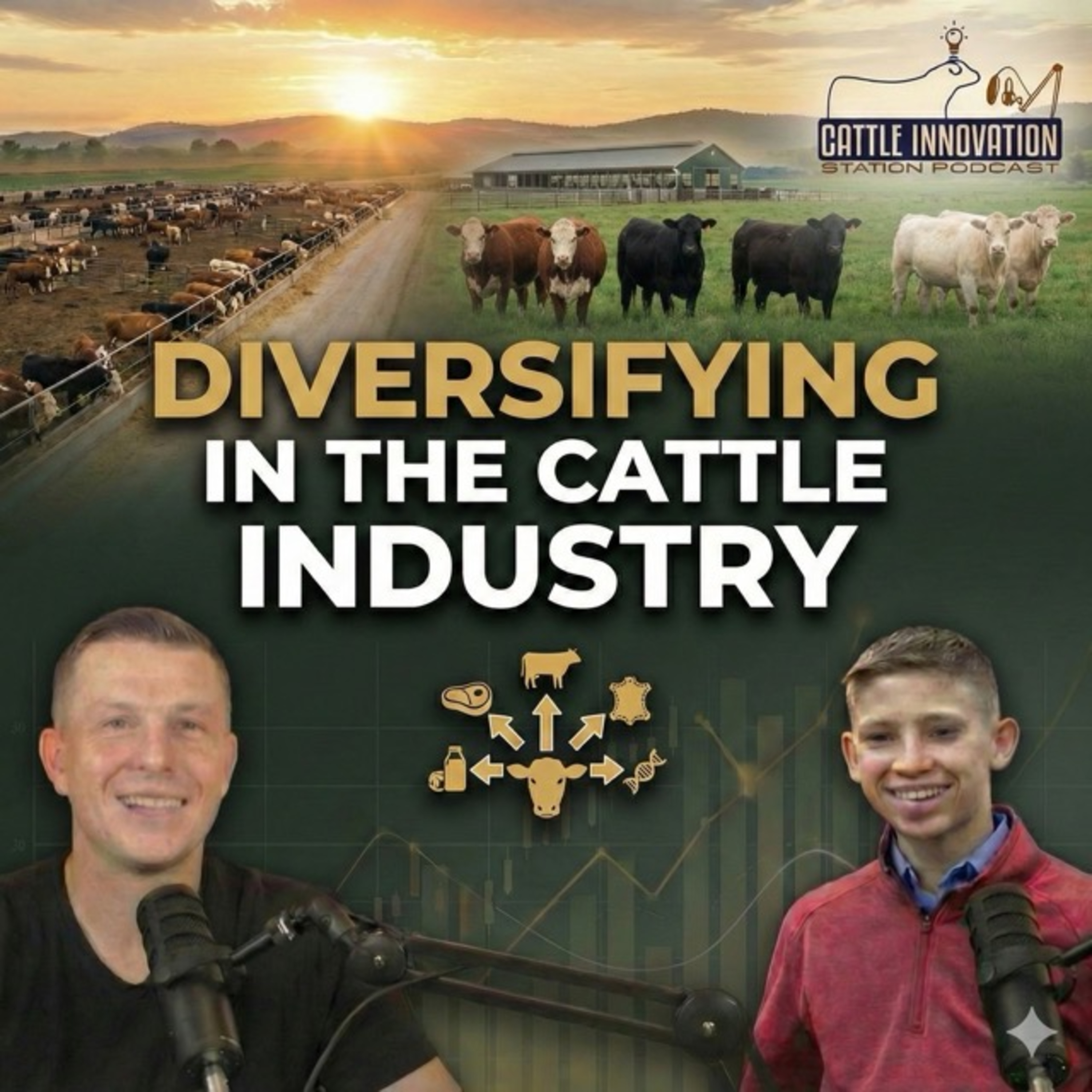
About This Cattle Innovation Station Episode
Most cattle producers know they should protect their herd. Few have a clear plan for how — or whether insurance, frozen genetics, or both make sense for where their operation is right now.
In this solo episode of the Cattle Innovation Station podcast, Baxter Whitworth breaks down every option on the table — three livestock insurance policies and two frozen genetics strategies — with real pricing details from Specialty Risk Insurance and Elgin Breeding Service. You'll learn exactly what each option covers, what it costs, and which stage of your cattle business each one makes sense for.
You'll learn the difference between full mortality, pasture policy, and embryo calf program insurance, what named perils means and why it matters when you file a claim, how frozen semen and embryos act as a self-insurance policy while also generating cash flow, why one cattle industry expert recommends using insurance until you can get frozen genetics — then using both, and why frozen genetics should never be treated as only an insurance policy.
If you have high-value cattle and no protection plan, this episode gives you the framework to build one.
Budgeting for Your Cattle Operation
Elgin Breeding Service — Semen Collection and Frozen Genetics
Specialty Risk Insurance
Cattle Innovation Station
Baxter Whitworth: You are not immune to crazy off-the-wall accidents happening in your cattle operation. But you already know that. Cattle getting sick, Mother Nature having her own plan. It's inevitable. But these cattle are your main source of income in your cattle operation. So how do we protect our operation from stuff like that that happens? Well, today I'm gonna walk you through every option on the table, insurance policies, frogen. and frozen genetics and when each one actually makes sense for your operation so that you can decide what fits your herb best. It's time for another episode of the Cattle Innovation Station podcast. I'm your host, Baxter Whitworth, and alongside you on this podcast, I learn how to be profitable in the beef cattle industry. So today on this episode, we are going to be talking about the different ways to protect to protect your herd, whether that be through different forms of mortality or insurance or frozen genetics. So In this episode, we will be discussing the different insurance policies and how frozen genetics can be used as a safety net in your herd. But before we begin, I will mention two things. First, I will be bringing up the facts in this episode and the scenarios for which these different tactics can be used to protect your herd and how these policies and tactics were intended. but I will not be it is it is your job to decide. What will work best for your operation? Also, my sources for this episode is Mr. Jacob Steff, who works for specialty risk insurance. And he has shared with me some great insight on these policies and how they've affected his own operation. and so our my other source is Elgin Breeding Service, which has been a longtime sponsor and partner of the show. And I highly recommend that you go. check them out if you are interested in getting a bull collected. So, why do we need to protect our cattle through some form of insurance policy or some way to protect their our investment in them? Well, first of all, in the cattle business, our main form of income is the sale of our cattle. So, cattle are also living beings, and that makes the risk inherently higher that something will go wrong. and so we need to protect our investment because In a business, you want to mitigate risk so that you have your income and cash flow so that you don't go bankrupt. Two main options to protect your herd. First, insurance policies. An insurance policy would work pretty similar to a car insurance policy where you would take out a policy with a company and make your payment plan. and we'll talk more about the different plans later, so stick around for that. The other way to protect your herd is through frozen genetics. This is where you freeze semen on high performing bulls or embryos on your high performing cows. This requires taking your animal to a company for them to be collected. And we'll also talk more about that Alrighty, so now we are going to get into the fun part of the interview discussing the insurance policies. And before I start, let me preface by saying that the details that I'm going to give you on these insurance policies are specifically from specialty risk insurance and Mr. Jacob Steff. and this is just to give you the basic idea of what the insurance policies could look like for your operation. Obviously, the details would vary a little bit depending on. the insurance company that you decided to go with. but this is it this is just to give you the general idea. So to start off, we're going to have the full mortality insurance policy. This covers the death of your cattle for anything except for negligible negligible acts. And then obviously if you have a pre existing health condition for your animal that you're wanting to insure, then you can't do that. But It covers almost everything besides negligible acts, which if you're in the cattle business, then obviously you care about that animal and your business, so there shouldn't be any negligible acts anyways. now with the extra coverage that this policy provides, it does have a seven to eight percent cost for the value or the insured value of that animal. For example, if you insure ten thousand dollars on a heifer, and that that would be about seven to eight hundred dollars a year. and paying that you can pay with or at least with specialty risk insurance, you can pay monthly, quarterly, or yearly. Now the next policy is the what they would might would call the pasture policy. This establishes a stated value on the herd. So for an example, you could say about thirty five hundred dollars per cow. And that that covers named perils. So mainly catastrophic events like extreme weather, fire, lightning, hail. It can include some feed contamination, water contamination, stuff like that. but with that name those name perils, it typically does not cover sickness of individual cattle. Like issues like bloat. So because it's because of the less or the lower coverage that it provides for your herd, it's it's more economical. So It's about two to three percentage, two to three percent of total insured value for that animal. So that that's obviously a lot a lot more economical and less expensive than seven to eight percent. It also includes an automatic calf coverage of two thousand five hundred dollar under the cow's value. So when that cow has a calf, I believe until weaning that calf is covered for twenty five hundred dollars. Next up, and this one is actually pretty neat and I believe is unique to specialty risk insurance. It is called the embryo calf program. It's designed to protect against catastrophic losses in embryo. programs such as so if you if you have some recips that you have implanted embryos into and you have an embryo program you can take out an insurance policy on those recips and on those embryos but the embryos I believe have to be implanted for the insurance to apply. So when the the coverage does drop off of the cow after she has the calf and moves towards, I believe, five thousand dollars standard for that calf. And while it's in the resip, that's thirty five hundred dollar coverage. This is also on a named perils basis, just like the last policy. And the cost of this one, this is again standard There is some deviation. The cost for this one is $25 a head, but he's had coverage that has gone up to $20, $20,000 before. So that's it's definitely some fluctuation, but the standard is a $25 ahead, $3,500 coverage, and a $5,000 coverage on the calf once it's born. Also, that coverage does not start until until that cow, that recipt is confirmed sixty to ninety days pregnant. Next Next up is our embryos. You can create or collect oocytes on your cow so that you have her genetics frozen and to ensure her genetics. You can either use IVF or embryo transfer. And we'll actually talk about the difference between those in a different episode at some point. So make sure to be checking in regularly for an episode on that topic. But The basic idea is that you'll be able to have the genetics on that female frozen because of her embryos. And then also or the details on that is that so this is for one specific company that I have a pricing list for. The aspiration fee would be $125 on the day of aspiration. And then that would also for the first one to fifteen embryos is about a hundred and ninety-five dollars. and that's that's the basic the basic pricing structure. if you ever want to do embryo transfer, kind of find the company that you would like to do it with and ask them about their pricing structure because it does vary greatly between companies. And then finally our last policy, I guess you could say, that we're going to talk about, even though it's more of a self-insured situation, is semen. So this would be collecting semen on your bull so that you have it. Same deal as the embryos. You have those frozen genetics. So if anything happens to them, they even though you might not get a payout, you still have the genetics on that animal. So this Pricing structure is from Elgin Breeding Service, who is a sponsor of our podcast, and just great partners, great people. They do a great job, and since we're on a list of greats, they also have great customer service. So for Siemen collection, this can actually get even more detailed because the different things, different routes that you can go here. But assuming that you would have to utilize board that is I believe Assuming that you would have to utilize board, that is $13 a day for all bulls except longhorns. And if you have longhorns, that's $23 a day. Also, this probably doesn't apply to a lot of you, but if you want to do a certified semen service test so that you can export your semen, that's $875. And then again, additional tests for certain countries. So for the actual collection, it is Two dollars and sixty cents per straw to freeze. And then the semen collection. If it's not freezeable, I believe there's a forty dollar fee for that. And if you want to know more, I would recommend reaching out to Elgin Breeding Service. They can get you your full pricing structure. This one might be a little bit old. so I would recommend reaching out to them. So we've seen different ways to ensure and protect your operation. But what are the pros and cons of these different scenarios and different policies, I guess you could say. The next discussion will help you see a variety of many perspectives. So make sure to stick around. And while you're here, I want to know, you can comment on this episode, whether you're a Spotify or YouTube or whatever you are. I want to know what you're currently doing to insure and protect your herb. So moving on. Full mortality insurance. Here are the pros. It covers pretty much every cause of death as long as it's not negligible. Also, which we talked about, I mean, that's part of your business. Also, caring for that animal, you shouldn't have anything that is negligible. The cons of this policy though is the policy is pretty expensive from seven to eight percent of your total insured value, and that can be no joke for any animal that's ten thousand dollars or more of an insured value, and then you multiply that, that gets pretty expensive pretty fast. Also, another issue that applies to all forms of insurance policies is That is that it's a line item that these insurance policies, they're a line item in your budget that are non-revenue generating. So they do exist to help protect your herd if something happens, but they are not revenue generating. next up is the pasture policy. The pros is it covers up to twenty five hundred dollars on the calf's insurance, which is a pretty impressive and helpful bonus. Also, it is much cheaper than full mortality with about two to three percent cost of the full insured value. And the cons of this though is that it covers a limited amount of name perils. And again, it's a line item in your budget that is non revenue producing. So the the limited amount of name perils is can be an issue if the obviously if you take out that insurance policy and your cattle have some sort of health issue and that and they you lose that calf or that cow and that's not part of the name perils and you don't get that payout. and that's another one of the con that's one of the cons for the next program, which is the embryo program. And it kinda has the same cons as the previous that it is name perils, limited amount of name perils, and it is a non revenue producing line item. But the pros, it's actually a really cool program. I I think I it excites me. It protects your major assets and that are it it helps protect major assets that are cash flow opportunities, quite frankly. And It's at a very economical rate at a standard twenty-five dollars per embryo. So I think that that's a pretty good option for people to look into, but we'll talk about use utilizing that a little bit later. Frozen genetics, the pros is that it keeps the genetics of it keeps the genetics of that animal alive. Even if they pass away. So even though that animal may pass away, you still have those genetics in your semen tank to utilize how you see fit. Also, a pretty cool thing about frozen genetics is that it creates cash flow opportunities. not only does it ensure that your high quality genetics pass on, but also ensures your finances because it is giving you a it gives you cash flow if you ever need it. Of course you still have to sell that, which can be one of the cons is that in a policy, as soon as they determine that that death falls in within that policy's within that policy, then you you get that payout. But with the frozen genetics, then that's not a payout that is you have to go and actually sell that, which requires time. That you could be spending on something else. So let's talk about the use cases for these different insurance policies. We'll first start off with full mortality. Full mortality, use it to protect high value genetics. This is what it was intended for. Show cattle, donor cattle, anything that is more expensive than your average genuine. Cow or bull in your herd. even Mr. Jacob Steff, who again I'll mention he works for specialty insurance, but he also he raises his own, he has his own Angus operation. He says that he recommends using insurance policies until you are able to get frozen genetics on your high value cattle. So for cattle, Well we'll say you have a good donor prospect and maybe we'll say she's showing she's a good donor process prospect and you're showing her to market her genetics. he would recommend taking out an insurance policy on her for say till she's two years old. So that'd be the her first two years of her life. Taking out an insurance policy on her and that would protect her until she has that calf and then you aspirate her. to have her genetics that would also act as an insurance policy. And that that recommendation makes a lot of sense to me personally, because once you have those frozen genetics, that does kind of act as a self insurance policy. But by taking out that insurance, you have those genetics or the the at least that asset the investment in that asset protected. Next up is the pasture policy. So Next up is the pasture policy. You can use this to protect your entire herd at a more economical value and level. So this would be something that you could utilize for all your cattle on pasture. it's a great way to have a payout that can you can reinvest if something unexpected happens. So even if you have a cow pass away, if it's under that name peril, you can reinvest that payout to help you. not have as much of revenue loss. And then next, my favorite, or at least my favorite policy, the my favorite just it gets me excited. None of the I wouldn't call any of these better than the rest. Is the embryo calf program. This is a great way to protect your investments in an embryo program because an embryo program can get expensive pretty fast when you calculate the cost of the genetics for that are in those embryos, the aspiration that is done to have those embryos or the collection of the embryos, depending on ET or IVF. and then the recips on those can be very expensive. So having those having that insurance policy is a great way to protect your embryo program, your embryos, so that if there is a major event that happens, you get refunded for some of those losses. And then finally, last but not least, is our frozen genetics. It's actually Don't don't use frozen genetics as only an insurance policy because they're a l they're a little too expensive to utilize only as an insurance policy, but it should allow you to improve your herd, also increase cash flow, and get your genetics out there to maybe increase income on your cattle side, also if they prove beneficial from a frozen genetics standpoint. It does not help you to in it it's a bonus to help you to insure your operation, but it should not it's not economical. It typically does not make sense to utilize it only as an insurance policy. But that is a great bonus of frozen genetics. So in conclusion, it is important to protect your herd, and there are many ways that you can do that. However, when utilizing frozen genetics, make sure that it will be a profitable investment. It is not on like we just mentioned, it is not only an insurance policy. It should anytime you invest in frozen genetics, it should be a line item in the budget that brings an ROI. It should be profitable. The insurance is a bonus. It should be profitable. Also make sure that you have room in your budget if you do decide to take out an insurance policy. It can be great for your operation to have an insurance policy if something goes wrong, to mitigate risk, increase that well, not increase the cash flow, but make sure that you don't lose as much revenue if something happens and And so, but it's also a curse to your operation. If you can't afford that policy and you take it out, then you're you're insuring against something bad happening, but you've you've done something bad to yourself in that situation. If you want to know more, so obviously if they're if you're gonna take out an insurance policy, make sure there is room for that policy in your budget. If you want to know more about insurance policies though, or sorry, if you want to know more about budget budgeting for your cattle operation, I will link an episode that we've done in the show notes about budgeting. And so if you don't know where the show notes are, that is below the episode show notes or description if you're watching on YouTube. You click on that and it'll have a description of the episode and different links. And I will put a link to episode about budgeting in the description. Also in the show notes or description, I will put a link to a free resource that will give a breakdown of this episode and what the in the different insurance policies and frozen genetics that we talked about, the pros, cons, and how to utilize those. So, also to conclude this episode in one sentence, if we were to do that. I would say that there are many different ways that you can protect your cattle herd and mitigate risk from a financial and genetic standpoint. But make sure to choose what works best for your operation and figure out what stage of your cattle business you're at to see if this is even necessary for you. If it'll do it if it'll actually do more good than it could be too expensive for your operation. So just make sure that While you do need to protect your herd, make sure that you're actually doing it responsibly. So I hope this episode has provided you the information that you need to make those choices. And until next time, keep innovating the cattle industry. Sign it on.

 Apple Podcasts
 Castbox
 Castro
 Goodpods
 iHeartRadio
 Moon FM
 Overcast
 Pocket Casts
 Podbean
 Podcast Addict
 Podcast Republic
 Spotify
 YouTube