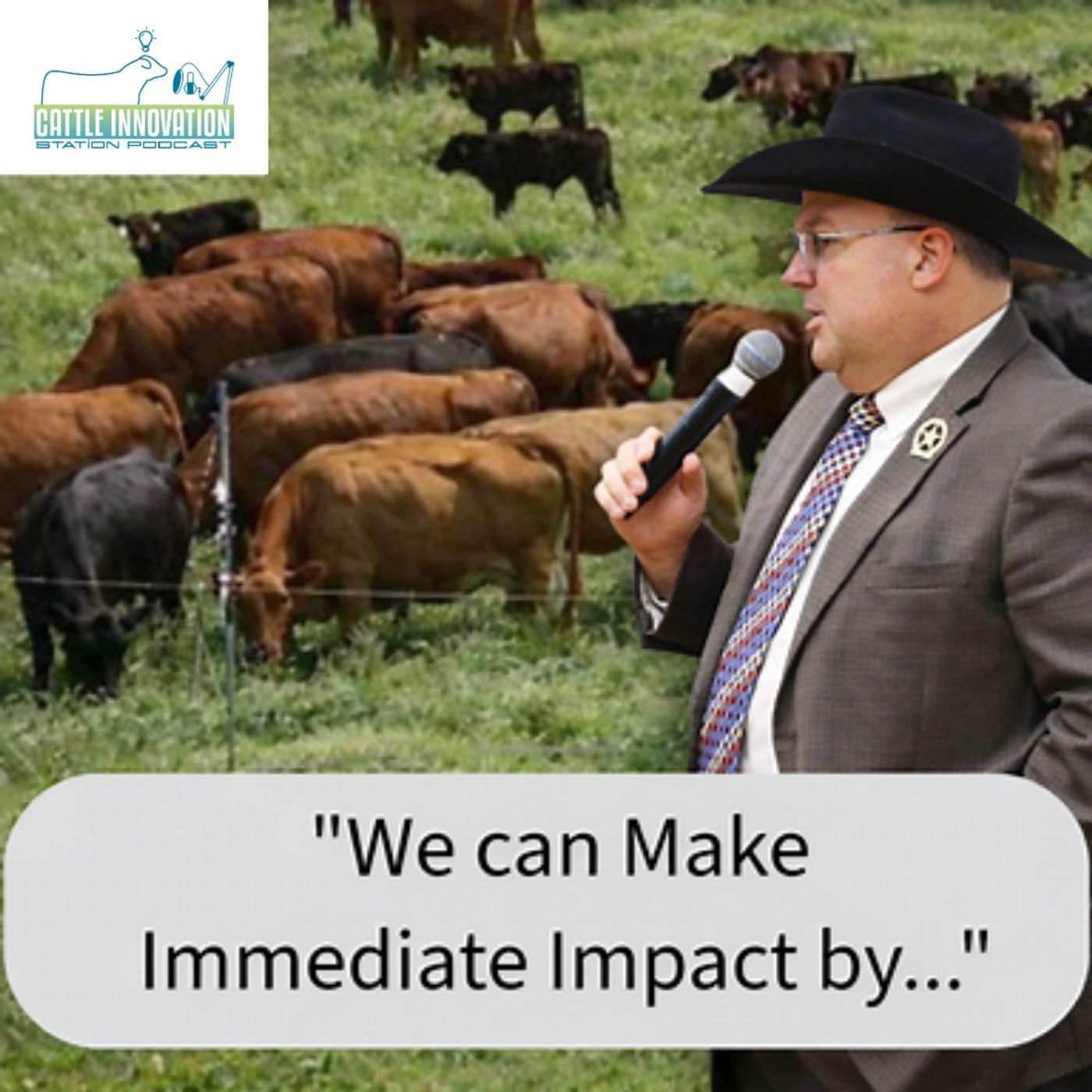
What's Hurting Herd Reproduction? Genetics, Nutrition or Vigor
About This Cattle Innovation Station Episode
Why your cows may be open — and the pregnancy tools, management practices, genetics, and hybrid vigor strategies that fix it.
Open cows are the single biggest profit drain in any cow-calf operation. But most producers don't know whether the problem is management, genetics, or something they haven't considered. In this episode of the Cattle Innovation Station podcast, Baxter Whitworth continues his conversation with Dr. Joe Mask, professor of reproductive physiology and animal breeding at Stephen F. Austin State University, to tackle exactly that question.
Dr. Mask breaks down the three pregnancy checking methods every producer should know — rectal palpation, ultrasound, and blood testing — and explains why early detection at 30 days changes the management decisions available to you. You'll also learn when estrus detection patches are worth the investment and when they're a waste of money, how poor nutrition destroys reproductive potential faster than any genetic problem, and why hybrid vigor may be the most underutilized profit tool in the commercial cow-calf herd.
If your herd's conception rates aren't where they need to be, this episode gives you a systematic way to figure out why — and what to fix first.
Topics covered: cattle reproductive efficiency, pregnancy checking cattle, beef cattle ultrasound, blood testing cattle, estrus detection, estrus patches, cattle herd management, body condition score, bull management, breeding soundness exam, beef cattle genetics, genomics and EPDs, hybrid vigor in cattle, heterosis, cow-calf profitability, open cows, Cattle Innovation Station.
What are the best pregnancy checking methods for cattle? The three main methods are rectal palpation, ultrasound, and blood testing. Ultrasound allows detection as early as 30 days and can determine fetal sex. Blood testing provides reliable results chuteside in about 20 minutes without specialized equipment. Rectal palpation remains cost-effective and widely used. The best choice depends on your facilities, budget, and how early you need results.
When should I use estrus detection patches on my cattle? Estrus patches are most useful when you're running an AI program based on observed estrus rather than timed AI, and when you can't watch cows around the clock. If you're using a strict timed AI protocol, patches add cost without meaningful benefit. For natural service, they can help confirm breeding activity but are optional depending on your management style.
How does nutrition affect reproductive efficiency in cattle? Nutrition is the primary management driver of reproductive efficiency. Cows need to maintain a body condition score of 5 to 6 to re-breed within 45 to 60 days postpartum. Cows that drop below a 4 BCS will struggle to cycle back. Hay quality varies significantly — testing your hay and understanding protein content is essential to managing supplementation costs and keeping cows in breeding condition.
How heritable is reproductive efficiency in cattle? Reproductive efficiency has lower heritability than traits like growth or carcass quality, which means management has a larger immediate impact than genetics. However, selecting for fertility traits — heifer pregnancy rate, stayability, scrotal circumference in bulls — creates cumulative genetic improvement over generations. Genomically enhanced EPDs help identify these traits earlier in young bulls.
What is hybrid vigor and how does it improve cattle reproductive efficiency? Hybrid vigor, or heterosis, occurs when crossbred cattle outperform the average of their parent breeds in traits like fertility, longevity, and calf survivability. F1 crosses — particularly Bos indicus crossed on Bos taurus — show the strongest heterosis. Even within-breed outcrossing using genetically distant bulls can generate meaningful hybrid vigor in a commercial herd.
Baxter: Well, I hope you learned something from this episode of the Cattle Innovation Station podcast. And if you did, make sure to share it with somebody so they can gain the knowledge that you have as well. And make sure to follow on whatever streaming platform you're listening on. And until next time, keep innovating the cattle industry. Signing off. It's time for another episode of the Cattle Innovation Station podcast, where we keep you current on beef cattle industry events, help you innovate your herd to turn a profit and help innovate the beef cattle industry so we can feed more people on less land. I'm your host Baxter Whitworth and today I'm interviewing Dr. Joe Mask. Dr. Mask, ⁓ what can we expect to kind of learn more about today? Have you ever had a cow not breathe back? We're going to help fix that today. First of all, we're going to learn about which tools are best for pregnancy checking in your operation. But we're also going to learn what makes your cattle herd reproductively efficient or reproductively inefficient. Is it genetics? Is it management? Or is it hybrid vigor? Well, that's what we're going to learn about today in this interview with Dr. Joe Mask.
Joe W. Mask, Ph.D.: Well, think, Baxter, we've kind been talking about reproductive efficiency and how do we use different technologies. And I think that today we're going to talk about other tools that we have in our toolbox and then maybe even get into some management versus genetics or maybe hybrid vigor as well.
Baxter: Yes sir. So ⁓ when we talk about reproductive tools, a lot of times what surfaces to our mind is like we talked about in the last episode, AI, IVF, ET, and those are all very important tools that we can use. But the tools I want to talk about right now are the tools that just help us manage our cattle better from a reproduction standpoint. And so what I want to start off with is talking about ⁓ better ways to pregnancy check our cattle. So what are some tools that are new or maybe even not so new that are great ways to pregnancy check cattle versus kind of the tools or practices we could also be using from a more manual standpoint.
Joe W. Mask, Ph.D.: You know, Baxter, one of the things that we have is rectal palpation. You know, that's one that we've been using for a long time. you know, basically we'd go in the rectum of the female and we'd fill through the rectal genital pouch down into the repro track of that female to determine pregnancy, you know. And there's veterinarians out there and there's repro techs out there and palpation techs that, you know, sometimes, you know, 45 days to 60 days or so, some even a little better than that. of getting some of these cows caught whether they're bred or open. I think palpation is one that's been cost effective for years, it's been reliable. But now with the technology of ultrasound, we can do so much more, we can do things a lot closer to time of insemination. We can even sex these fetuses as well using ultrasound technology. And so I think it, I was visiting with a gentleman that I worked with yesterday because ⁓ I'm fortunate enough to have one ultrasound machine here that I use, plus I've got another one coming, a newer machine that actually has some Doppler capability of looking at blood flow through Doppler ⁓ to look at some of ⁓ these follicles and different things. But now we're getting down to about 30 days, 35 days, being able to tell if these animals are bred. ⁓ And that early detection means a lot. ⁓ Especially if they're open, we can run those cows back through and try to, if we want to try to AI them one more time or we just want to put them with a bull for cleanup. And then we can, like I said, we can determine fetal age. We can determine the fetal sex at that time as well. So the earlier diagnosis of pregnancy, I think, gives us the ability now with that ultrasound is to make hard decisions. Do we need to call that cow? Do we need to try to re-breed her? And I think with the cost of it, it's also a cost savings because there's been a time where we still know that there's early embryonic death laws in Europe. We know that those cows will reabsorb. We know that those issues are there. But if we can make decisions ⁓ of getting that open cow, Maybe we move her to another breeding season. She's a spring calver, we move her to the fall or vice versa. Or we just try to say, hey, we've tried long enough and now it's just time to maybe cut our losses. With the cost of cell-borne cows today and cold cows, it's a little easier to haul them to town. ⁓ But I think it's the cost savings by using those technologies, especially when we we figured out a lot earlier.
Baxter: Yes sir. So, ⁓ you talked about ultrasound and you talked about doing the palpation. What about doing blood testing? ⁓ Is a good tool to use?
Joe W. Mask, Ph.D.: great question, Baxter, and that's one that I think that more people ought to be using because the reliability of looking at those cows being bred, using blood at 30 days, you can tell bleed those cows just as easy as you can do anything, and then in 20 minutes you've got a result. so chuteside diagnosis helps out on people that maybe they don't have the capability or the know-how to do. rectal palpation or they don't have an expensive ultrasound machine at their disposal. I will tell you that there's times that if I'm uncertain, especially if I'm just going to do a rectal palpation, if I'm uncertain, I might pull blood and do a blood test as well because I keep them on hand ⁓ because I think they're that reliable. so ⁓ the technology is getting better and better. And once again, that gives us the opportunity that we don't have to haul cows to the cell or hawkhouse of the veterinarian to check. But I will say, Master, the one thing that it does do or adds to it is to make sure that we've got really good facilities. Because at the end of the day, it's all about animal welfare. It's all about us. And so we need to be protected. We need to make sure before we do any of this, you know, and that's maybe something we didn't even talk about the last time we're talking about A.I. or for E.T. or IVF is that we've got to have good facilities. good shoots, good working pins ⁓ to make sure that we're kind of covering that animal when it comes to the animal welfare side, but then to make sure that we're safe as well. And so I think that's, all three of those are great ways of determining pregnancy.
Baxter: Yes, sir. ⁓ So we've talked about determining with those technologies or techniques that we just talked about. what about detecting estrus? So I know that ⁓ a popular is estrus patches. What are your thoughts on that? And when should a producer use those? And when is it maybe not necessary? ⁓
Joe W. Mask, Ph.D.: Well, know, Baxter, I've grown. I guess since I've been doing this since the early 90s, you know, we've seen a lot of things from a lot of different types of patches that we've used. They, you know, had a capsule in there and it go and mount some so many times and you know, that capsule would break and you know, they would be red. It's called a K-MAR patch. And then we went to these Estratech patches. This kind of the lottery style scratch off tags. ⁓ Now, like I said, you know, other than that, we've got some electronic patches. that you've got a base station that kind of picks up when that cow is being ridden as well for that. And I would tell you that the use of patches is really good when we're trying to use AI programs. If we want to do estrous detection and AI those cows 12 hours after the onset of estrous, an estrous tag is great. I think that if we have ⁓ minimal or marginal labor. And in most people nowadays that have cows have jobs in town or they're doing something totally different. They're not at the ranch all the time or maybe they're doing, maybe they have another, they're either cutting hay or they're shredding pasture when they're trying to catch, know, eats as well. I think those estrus type patches or ear tags that we can use are great for that. And I think that that gives us the ability to know when those cows are in estrus. But once again, we've got to check them. ⁓ I think a really good source is when young people have show heifers and they're trying to get a bread and they're in the school barn or they're at somebody's place that they're not being able to watch them while they're in school all day long. The estrus tech patches are great for that ⁓ because it gives us the ability to know what that cow's doing when we're not around. ⁓ ⁓ I would tell you that if we're going to use a strict timed AI program, if we're going to just time AI those cows after we sync them up, know, Estratec patches are not all that, I mean, they're not that useful to us. ⁓ So I wouldn't utilize them on cows if I'm going to just time AI. ⁓ I've got that's got a project right now that we're using some different protocols that, you know, some of those cows will be ⁓ bred on estrus and some of them will be bred timely. And so those time-day eye cows, I will not, you know, instruct her or will not, you know, it's not part of the protocol to put estrutech patches on. And so, you know, if we're trying to catch them in estrus and breed them, you know, 12 hours after the onset or a little later, that 18 to 21 hours or so on sex semen, I think they're great to use. ⁓ the time they have, I don't know if they're really that useful.
Baxter: Yes, sir. That makes sense. I think that's a great way to use it and not waste the money of having to spend it when you use it when you don't have to. But I do have a question about using it on natural service. Is it of any benefit to use it on natural service so that you might can know ⁓ when when that bull might have bred the cow or is that really not necessary?
Joe W. Mask, Ph.D.: think it goes back to that management decision. If you're not there and you're trying to see when the bull's breeding cows or if old Bessie got bred or what have you, ⁓ I think it's okay to use. I don't think their costs were hitted to use those patches. ⁓ But I think it goes back to do we have the facility or is that cow gentle enough that I can put the patch on correctly? ⁓ And then am I gonna watch them? And so I think it goes back to management again. is what decisions need to be made, and then what's your operation cause for. I know that we might visit or you might want to visit a later or something even about breeding seasons. But we're trying to really hone in and tighten up our breeding season. That even helps with those bull bred cows where you kind of know prior to palpation which cows the bull did cover.
Baxter: Yes, sir. All right. Well, before we move on to something else, is there any other technologies from a reproduction management standpoint that we need to be aware of that can help us be more profitable?
Joe W. Mask, Ph.D.: As far as technologies, I think we've covered a lot of them, the ones that are out there. I think that some of those things that we really need to look into and I think that we really need to start, all of us need to be thinking about it when we talk about reproductive tools. The cedar implants, that's another one of how do we get the extra synchronization. ⁓ Really utilizing the timed AI protocols or some of those protocols that fit us and we can kind of set those cows up when we're going to be around. or maybe when you're on vacation, or maybe when your AI tech can get there. We talked about ultrasound, and I think that's one of those tools that if you have the capability of using it, it really tells you some things. Other things that we can use that, especially when we talk about breeding, ⁓ is one of those tools is genomic testing. I think that we have got to get away from you know, just looking at common EPDs to look at more genomically enhanced EPDs, especially on these younger bulls. You know, we don't, we're not having to wait a long time to see what that bull can produce. If we're using genomics, you know, we're going to get a lot more data. And so I think that we're in a data driven world today, especially in the cow business and how do we improve genetics? And I think some of those tools are going to help us. But I think that we also have to know that all of these are tools. And it's going to go back to management, it's going to go back to profitability, and you know what we said earlier is match the technology and the tools that you have for your operation goals. And I think at the end of the day, we're all seeing higher costs, higher prices in the sale boards, higher prices on seed stock cattle. However, we're seeing higher input costs as well. And so how do we leverage those different technologies to face the goals or to reach the goals that we want?
Baxter: Yes, sir. So you've said this numerous times, but ⁓ an open cow is extremely costly to your operation. ⁓ a cow or in reproduction is the baseline of a cow calf operations profitability, because without that, there is no product for them to sell. So when it comes to cattle that are reproductively efficient, ⁓ how
Joe W. Mask, Ph.D.: I'm
Baxter: does management impact their reproductive success? ⁓
Joe W. Mask, Ph.D.: think it's a great question, Baxter, and I think that those are the things that sometimes we forget about. But when I look at management impacts, the first one that I look at is nutrition. And I think that's one of the biggest drivers that we have when we talk about reproductive efficiency. Open cow is an open cow, but why is she open? Number one, what is her body condition score? And I think we really need to hone in and understand the difference in the body condition score. system one to nine, knowing that we need to be somewhere in that five or six on most cows. And we know that there's going to be situations ⁓ that cows are going to get down to that four and there's going to be situations cow gets to seven. ⁓ The thing is, I think the management side of it is, is how do we manage those females? I would tell you that I still think that most of our time should be put with the female. And when I talk about managing that female is we have three different types of females that we manage or I manage at least on our place, you know, and I think a lot of people will manage some of these. We have to manage Weingland heifers. We have to manage breed nage heifers. We have to manage dry cows and have to manage wet cows. And so, and then we have to manage those cows throughout the year. And so, you know, how do we put them in different places? Because those growing heifers, those weanland heifers and those long yearlings that are ready to be bred, they take different management than a dry cow does. Those dry cows take different management protocols than a wet cow does. It's got a calf at her side and bred back. And so we need to make sure, and this is just kind of the gold standard, I guess, is those cattle need to be somewhere in that two and a half percent of their body weight a day of feed to kind of maintain those cattle. And I think that we've got to make sure that one thing that we do as far as nutrition is really understand in the wintertime what hay are we feeding. I hear people all the time talk about, I buy my hay by the roe or I buy my hay by the square. Well, that's fine. But what's the nutritional value of that hay? Not every hay bale is the same. So if you've got hay that looks really pretty and you test it and it's at 2 % protein, well, how do we maintain body condition score? We've got to put out more cubes. We got to put out more lick. We got to put out more tubs. And so, you know, I would say that, you know, sometimes it's better that if we would start thinking about we buy hay by the ton and by the analysis of it. We don't do that. But, know, a bella hay that costs you, let's just use an example of a hundred dollars just for easy figuring. You know, if that hundred dollar bella hay is two percent protein versus a hundred dollar bella hay that's 16 percent. Well, it cost me a lot less money to feed that 16 % protein. Hey, because I'm not having to add extra supplementation in the wintertime. And so, nutrition and body condition score, I think are paramount in this deal. I think sometimes that we are our own worst enemy. when it comes to ⁓ the nutrition on show cattle. I think we get them too fat as babies sometimes, and then we have reproductive issues trying to get them bred. And so we really got to manage those cattle as well. Plus, those first calf heifers. Managing them when they're in that third trimester of pregnancy, they were not feeding them too much ⁓ because that's the most optimum time of that calf growing in that last trimester. ⁓ know the calf is not growing in excess. But then how do we keep that cow in the condition that she needs to be as we talked earlier about those calving intervals being that 45 to 60 days or so after postpartum that those cattle will get re-bred. So management when it comes to that I think is important. I think the other part is that we all need to have a relationship what we call a veterinary client patient relationship of EC with a veterinarian to go through our health protocols, our vaccination protocols, our parasite control. What do we need to be doing? And I think that goes back to management too is to, there's some products out there that you can't use on bred females. And so how do we manage those cows to a point where the vaccinations that were used in the clostridials, the the respiratory, if vaccinations were using plus parasite control, how does that fit in? And then, I think the last part of it is basically that bull management. How do we manage those bulls that we're using? I don't know if we'll talk about it later, but I'm bringing it just shortly here, but breeding soundness exams, ⁓ very important. And I'm not concerned so much sometimes. I know we can look at the motility and morphology of sperm cells. under a scope and see what they're doing and we can look at volume and we can look at concentration. However, are we looking at feet and legs? we looking at, you know, bull has a corn or bull has a broke toe or a bull has, you know, if he's not extending himself, does he have an issue, ⁓ you know, with his genitalia? Does he have an eye issue? And so I think that, you know, bull management is another one of those things that's key when it comes to management. And I will tell you that ⁓ just in my opinion, that poor management when it comes to what we do destroys our reproductive efficiency and our reproductive potential. We can do that pretty quickly. ⁓ I've been in situations where I palpated cows and they're open and then I hear excuses. Well, she's open because I did this or I did that. And I think that that really rings true that we can destroy our reproductive potential pretty quick just on our management style.
Baxter: Yes sir, so ⁓ there's a lot to break down there. I want to start with nutrition. Like we mentioned earlier, ⁓ a cow that's being profitable is going to be feeding least two animals at one time. Her ⁓ and whether that be a calf that she's ⁓ carrying or a calf on side, she should be feeding at least two, if not three when she's weaning. or getting closer to weaning her calf on side and already being bred back. So how do we manage that nutrition knowing that we're likely feeding ⁓ at least two, hopefully, ⁓ cattle or two animals ⁓ when we're feeding that one cow.
Joe W. Mask, Ph.D.: think actually the first thing that we have to realize is we cannot be overstocked. We cannot be overgrazed with what the good Lord give us and that's grass. We have to manage our pastures to be able to manage that cow. Cows are ruminants. They need forage. They need forage and they need for microbe ⁓ the ⁓ They to ⁓ be on whatever percentage protein or ⁓ fat that your land requires and I think that that's an open-ended question because it goes back to what forage availability do we have and so ⁓ You know, I think that's the biggest thing I've heard it said a many a time and and I don't know who I heard it from the first time backster I wish I did because I'd give him credit that you know, the most profitable cow man is first a grass farmer You know when he knows how to provide grass and grow grass and forage for his cow That's the least the least input he has however saying that is it's not The least input because we have to do soil sampling of our pastures. We've got to do fertilization of our pastures You know, maybe we need to aerate and open up that soil of our pasture, but grass is number one and we cannot ⁓ Keep going to the point. Well, we'll just feed them in hay or we'll feed that to them. They need that green forage and so I would say all that goes back to if it's 12 % protein feed, it's 2.5 % fat or whatever it might be, it has to go back to what forage availability do we have first.
Baxter: Yes, sir. Well, ⁓ that's great. like you said, management really does probably play the biggest role into reproductive efficiency. But I want to talk about the other well-known, at least the other well-known part of reproductive efficiency, which is the genetics side of it. And so what is genetics? How much of a role does that play in reproductive efficiency? ⁓ And how heritable is it? And how do we need to make sure that our cattle are genetically set up? to be reproductively efficient.
Joe W. Mask, Ph.D.: Well, thank you. Starting I think the biggest things we need to plan for the next generation and we've got to figure out You know, how do we change that so we start looking at you know fertility traits like heifer pregnancy and stability in the herd We want those females that will reach the age of puberty earlier We know that those cattle that reach the age of puberty earlier will breed earlier ⁓ You know stay in the herd longer because you know, they're going to be producing now. I will tell you that there's you know ⁓ I think you have to look at retype as well. ⁓ Not every animal is going to come into estrus or going to come reach the age of puberty at the same time. But I think if we can look at those traits and we can look at start looking at bulls, ⁓ testicular growth, ⁓ can look at scleral circumference on those bulls. And we know that's a direct correlation to the age of puberty in these heifers. And so I think when we start to look at those different types of traits, that helps us. We also have to understand that we need longevity. And I think we have indexes in EPDs in most breeds that look at those longevity, those efficiency indexes, the stay abilities, the daughter queens, the daughter cow, whatever those might be, and really start to look at the genetic side. Genetics to me, in trying to to teach animal being and genetics here. know, genetics is a long-term process. You know, we're not getting from A to Z overnight in the beef industry because it takes a long time to see genetic change. But if we work on it and we stay consistent, I think we can do a better job. And the biggest thing is really understanding your EPDs, trying to utilize genomics to enhance those. EPDs and the genetic impact of the cow and then to learn from mentors. Not everybody's going to know everything about ⁓ genetics or animal breeding, but I will tell you, actually one thing that impressed me when I first met you, it's been a long time ago, that you were willing to go up to people ⁓ three times your age and ask them questions about breeding and what would their bull add or what would this cow add? And I think that those mentorships that we have in our life and I've had a lot of them that have helped me understand EPDs and what really we need to look at, ⁓ kind of improve the bottom line of the cow herd when we start to live together.
Baxter: Yes, sir. ⁓ I think that's great because obviously, like you mentioned, we have to manage the cattle well, but if the cattle aren't reproductively efficient themselves, that's not going to matter much. But another thing that does go along with genetics, but a lot of people don't think about when it comes to reproductive efficiency, is ⁓ hybrid vigor. when you hear the word hybrid vigor, You think of ⁓ crossing a Brahmin with a Angus or a Hereford or different breeds with each other to create hybrid vigor. even within breeds, ⁓ doing outsourcing or out-crossing genetics with other cattle that have been ⁓ many, many generations removed that don't have much genetic similarity can create hybrid vigor. So how does hybrid vigor play a role in reproductive efficiency and how can you implement strategies in your herd to use it.
Joe W. Mask, Ph.D.: But I think you're right on target. We think hybrid barrier heterosis. We think about that F1 cross. And as my time is with ABBA, I saw a sign every morning that said the common denominator, which was that Brahmin crossing back on these F1 females and true F1s. And there's nothing out there that I think that we get more. But it's not just boss Indicus versus own boss Taurus. It could be boss. on Bostorus and like you said it can be in your own herd using outside genetics and I think those situations we increase fertility, increase longevity, ⁓ we increase calf survivability as well because I think all of us can utilize outside genetics in our herd. There are some closed herds and I understand that and I'm not against any closed herds and I'm not saying that there's anything wrong with that but to get optimum Heterosis, I think you've got it used some outside genetics ⁓ in your herd to improve the things that you don't already have I will tell you you come to our place and I'm saying my wife and I and Jennifer's places You know, we're we produce females We don't produce good bulls because we don't have the type of cows that you know We concentrate more on the female side of things. However, you know, we have used bulls when we want to dabble little bit in the ⁓ market steer game or something like that. ⁓ So I think bringing in those outside genetics help us a lot. We've got a group of cows that were decent. Let's see, EPD for maternal milk. And that's not about how much milk they're gonna produce, but how many pounds of those wean calves. Well, then I could go outside and get another bull that maybe can strengthen my cow herd up. in that next generation of heifers. And so I think that we always have to be looking at that, you know, especially in a commercial herd. I think the biggest return on investment is when we utilize, you know, cattle that we can get heterosis out of. I was talking to some people this morning about some bulls that, you know, and these are, you know, F1 bulls to increase that. And so hybrid vigor is something I think that by using outside genetics or by using F1 females or producing F1 type cattle or F2 type cattle, we improve the lifetime productivity of our whole herd. If we stay with that same concept of just using our own bulls back on our own females, I don't know if we get as much productivity out of them. And so sometimes I think we can even get a little stale. And so that's how I would think hybrid vigors. really work in most operations.
Baxter: Yes, sir. So I think we've had a great talk about making ⁓ the different factors that play into making cattle reproductively efficient. But if someone is having a tough time and they're struggling with reproductive efficiency in their herd, ⁓ they're lacking quality conception rates, what should they kind of do to find out what's going wrong? Should they? try a generation of bringing in ⁓ completely ⁓ out-crush genetics to see if that helps or should they ⁓ really call hard to see if it's actually the genetics of that animal or maybe try different management strategies? How should they start off trying to figure out what they're doing, what's not working for their operation?
Joe W. Mask, Ph.D.: So, I think we need to really combine all three. I think we need to combine management with genetics and then with heterosis or hybrid figure to really figure out how do we become profitable. And I will tell you that the people that I consult with and have consulted with across the U.S. on different operations is that we can make immediate impact by just changing management strategies. we can make immediate impacts by that. Those management strategies of number one, getting those cows vaccinated on time, getting dewormed on time, getting them fed the right nutrition, we can make immediate changes if we just think about that. A lot of times I think that we get complacent, the cows are making money, this, that and the other. But I will tell you that where we're at today and with the cattle industry like it is, today in short numbers, ⁓ cattle prices are high. If we make some of these management decisions just to maybe start using AI, or maybe start using a different mineral protocol or what have you, I think that we can make big changes. And if we set ourself up ⁓ for when we start a rebuilding process, we start a big rebuilding process in this country. I think that the genetics are that cumulative impact that really make a long-term impact that we can have by just selecting different genetics and having somebody sometimes come in your herd and saying, hey, you know, be honest with people. You know, why are you using this bull? Or, hey, your calves are not doing this. I used to always enjoy when I was a county agent, I would go to the coffee shops in the morning and listen to producers after they got their cell-borne checks. before they bought new bulls and just to listen to them talk about you know those needs and I think that you know we're all like that and I think we can make those type of improvements and then when I think we can compound the efficiency when we start looking at outside genetics but I think most herds in most situations when they combine all three I think they've got better they've got better success but that number one I think still goes back to management.
Baxter: Yes sir, well ⁓ thank you Dr. Mask. I sure hope the listeners learn something about how they can increase reproductive efficiency in their operation because it truly is the baseline to be profitable as a cow calf producer.


 Apple Podcasts
 Castbox
 Castro
 Goodpods
 iHeartRadio
 Moon FM
 Overcast
 Pocket Casts
 Podbean
 Podcast Addict
 Podcast Republic
 Spotify
 YouTube